
How to Search Gratiot County Court Records
Court records in Gratiot County are searched through a mix of statewide and local tools. The Michigan MiCOURT case search is the top starting point for court cases across the state. The county's own Find hub routes users to that same state database. For daily hearings, the 65B District Court posts a live public calendar and keeps a public-access terminal at the courthouse. Traffic tickets carry their own layer through Court Innovations and the state eTix portal. Older files that were never scanned are reviewed in person, by phone, by fax, or through a written request to the county clerk.
A little prep speeds up any search. Have a full party name or a case number ready. Know the court level too, since circuit, district, and probate cases live in separate places.
The statewide MiCOURT case search is the widest net for Gratiot County court records and reaches cases filed across Michigan.
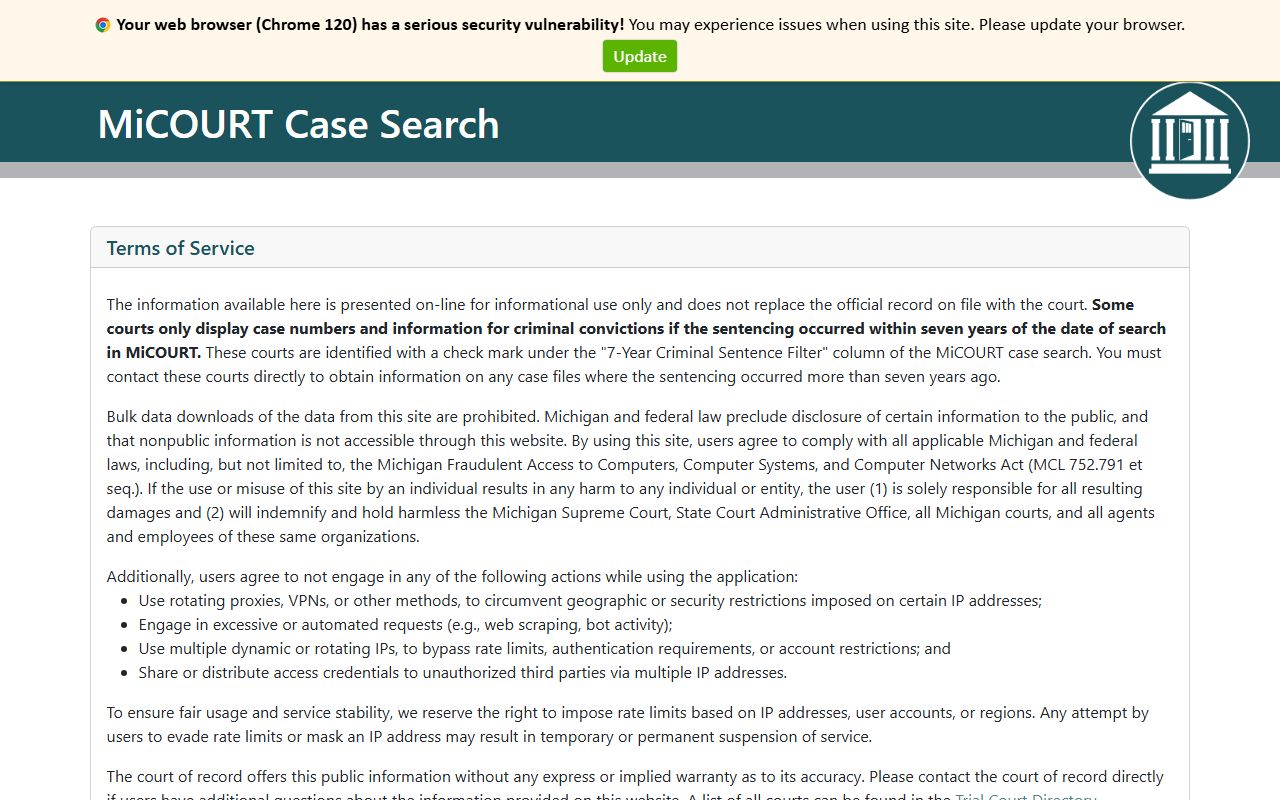
Its single form lets a resident search by name, case number, or attorney without a trip to the courthouse. The steps below track the usual path from the broadest tool down to a certified copy.
- Start with the court level: circuit for civil, family, and felony matters, district for misdemeanor and traffic cases, probate for estates and guardianships.
- Run a statewide lookup on MiCOURT case search when the county page does not point to a more specific portal.
- Use the district court calendar for daily hearing dates, and the 65B public terminal for deeper record review.
- Turn to Court Innovations for eligible traffic review and eTix for payable ticket or case searches.
- If a case is older or missing online, request a records check by phone, fax, email, mail, or in person.
- For a certified copy, use the county clerk request form or pay the copy fee listed on the fee schedule.
Not every case appears online. The county's Find hub connects local court cases to the State of Michigan database in one spot.
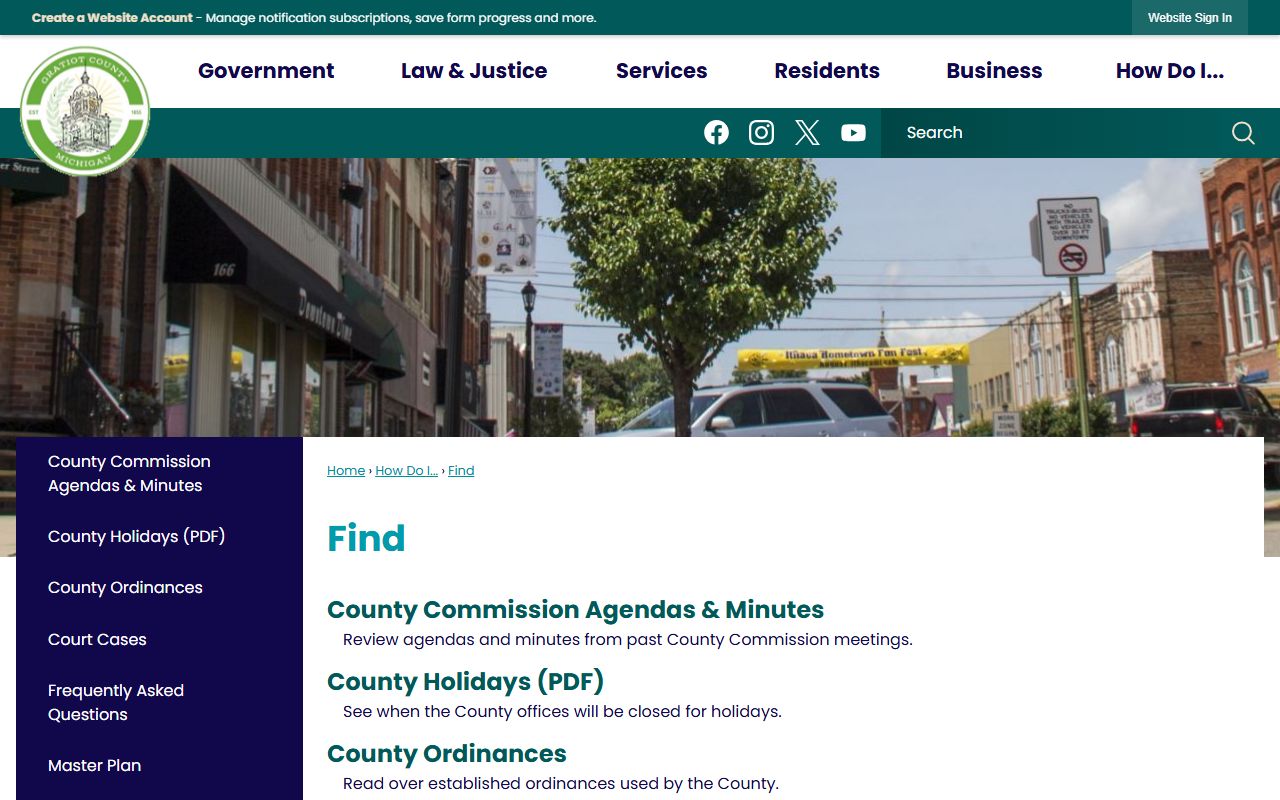
It is a handy jump point when a resident is unsure which court holds a file. Circuit filings, by contrast, always start at the Gratiot County Clerk counter before any broader state search.
The MiCOURT form keeps its fields simple, and none of them are required except the final search button.
| Field | Type | Required | Notes |
|---|---|---|---|
| Case Number | Text | No | Search by a known case number. |
| Party Name | Text | No | Search by a person or business name. |
| Attorney Name | Text | No | Look up cases by counsel. |
| Bar Number | Text | No | Attorney identifier lookup. |
| Lower Court | Selector | No | Filter by the originating court. |
| Submit Search | Button | Yes | Runs the query. |
The Gratiot County Judicial System
Michigan runs a layered trial-court system, and Gratiot County uses three local venues. The 29th Circuit Court hears civil, family, and felony cases along with appeals from the lower court. The 65B District Court handles misdemeanors, traffic, civil infractions, and small claims. The Probate Court manages estates, guardianships, conservatorships, and name changes. Each court keeps its own records and its own front counter.
The 65B District Court is where most day-to-day public case activity begins.
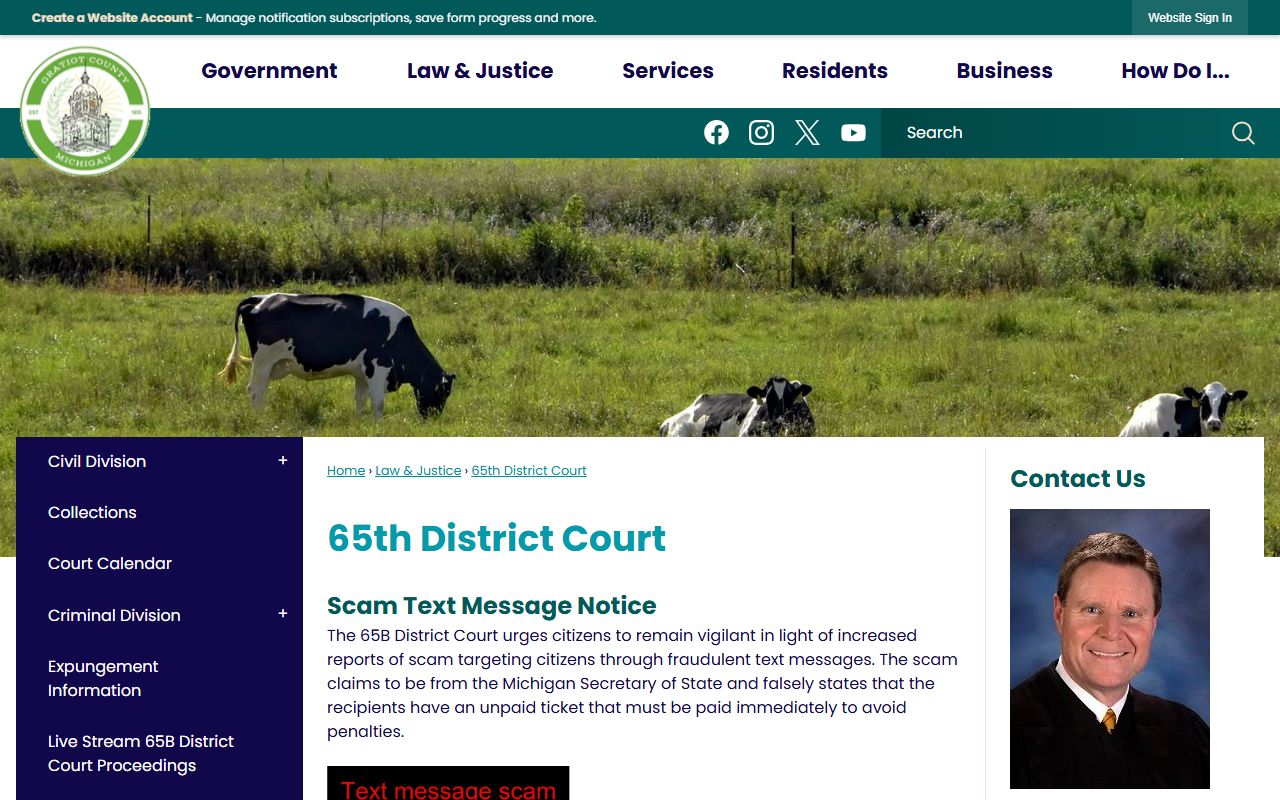
Its judge is Stewart D. McDonald. The circuit bench seats Cori E. Barkman and Shannon L.W. Schlegel, and Kristin M. Bakker presides over probate. All circuit civil, criminal, and family cases are filed with the 29th Circuit Court through the county clerk.
Case flow: District Court › Circuit Court › Michigan Court of Appeals › Michigan Supreme Court. Felony cases begin in the 65B District Court with arraignment and a preliminary examination, then bind over to the 29th Circuit Court for trial and sentencing. Michigan has no justice court or county court in this chain.
| Court | Jurisdiction | Address | Phone |
|---|---|---|---|
| 29th Circuit Court | Civil, criminal, family, appeals, felony after bind-over | 214 E Center St, Ithaca, MI 48847 | 989-875-5224 |
| 65B District Court | Misdemeanors, traffic, civil infractions, small claims, felony arraignments | 245 E Newark St, Ithaca, MI 48847 | 989-875-5240 |
| Probate Court | Estates, guardianships, conservatorships, name changes | 214 E Center St, Ithaca, MI 48847 | 989-875-5231 |
Michigan's court structure sets the frame that Gratiot County works inside.
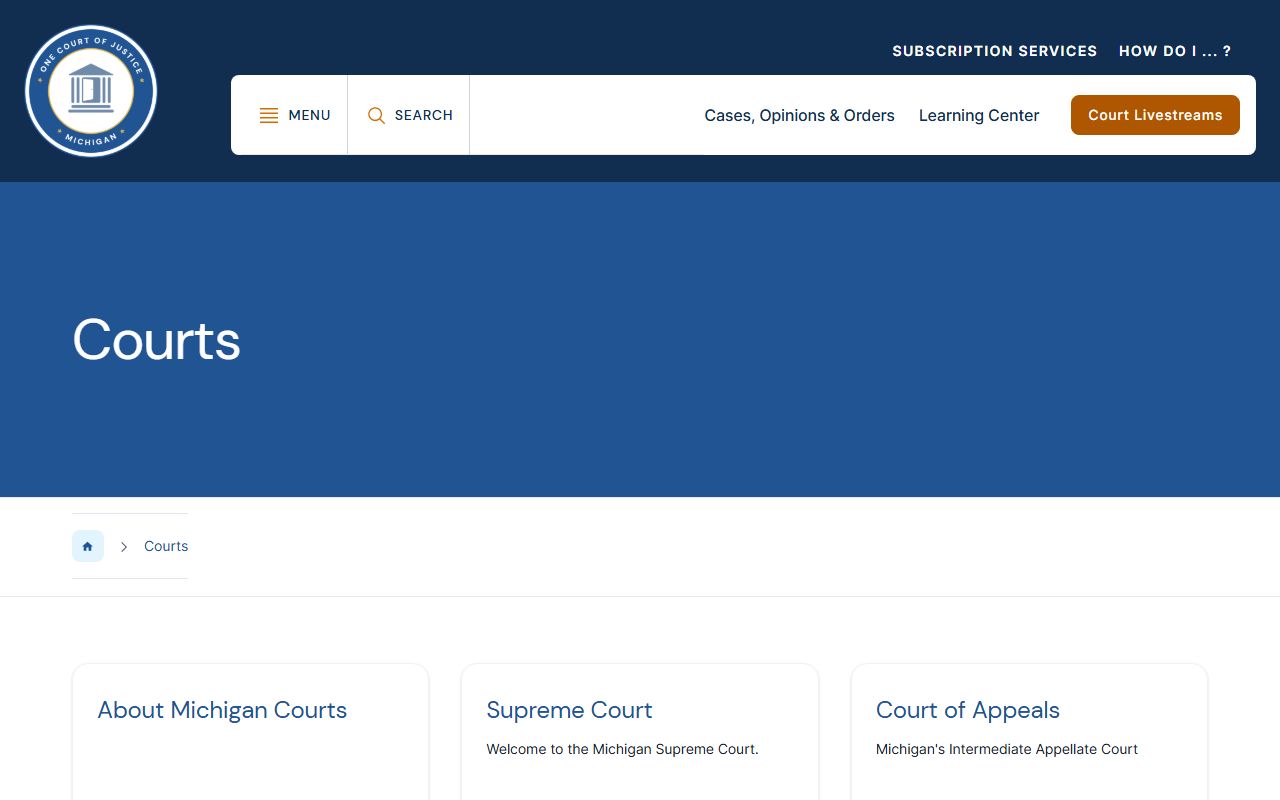
The Michigan courts overview lays out how circuit, district, and probate courts share the trial-court load statewide. Appeals move from the circuit level to the Michigan Court of Appeals and then to the Michigan Supreme Court.
Gratiot County Courthouses
The main courthouse stands at 214 East Center Street in downtown Ithaca, where Main and Center Streets meet. The district court fronts 245 East Newark Street and is connected to the main building, so the two share one campus. The sheriff and jail sit just east of the complex. The result is a single downtown courthouse block rather than scattered offices.
The building itself is a Classical Revival design by architect Claire Allen, with a 1901 facade. The 29th Circuit Court occupies the main structure alongside probate.
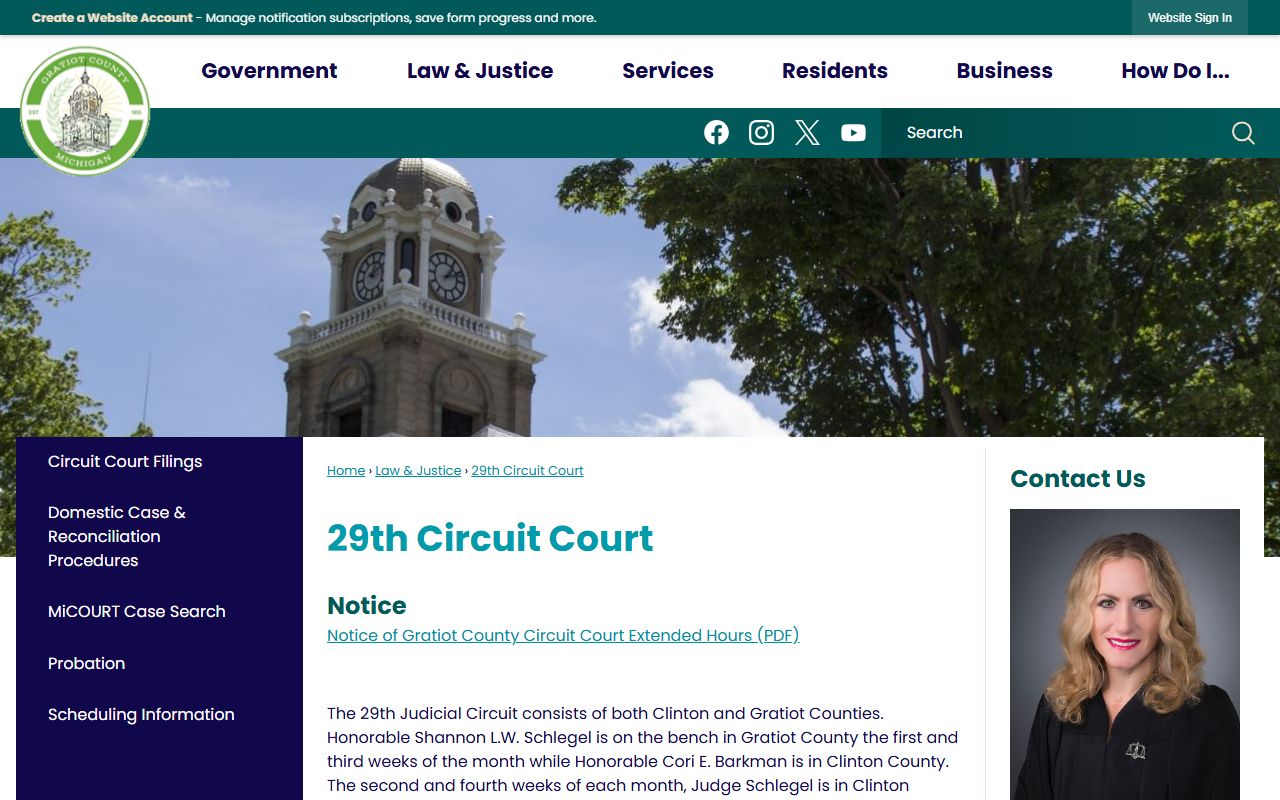
Circuit court hours run Monday through Friday, 8:00 a.m. to 4:30 p.m., and the office closes on holidays. Free visitor and juror parking rings the campus, and the county publishes clear directions for each approach.
The county keeps a full getting-here page for drivers and visitors.
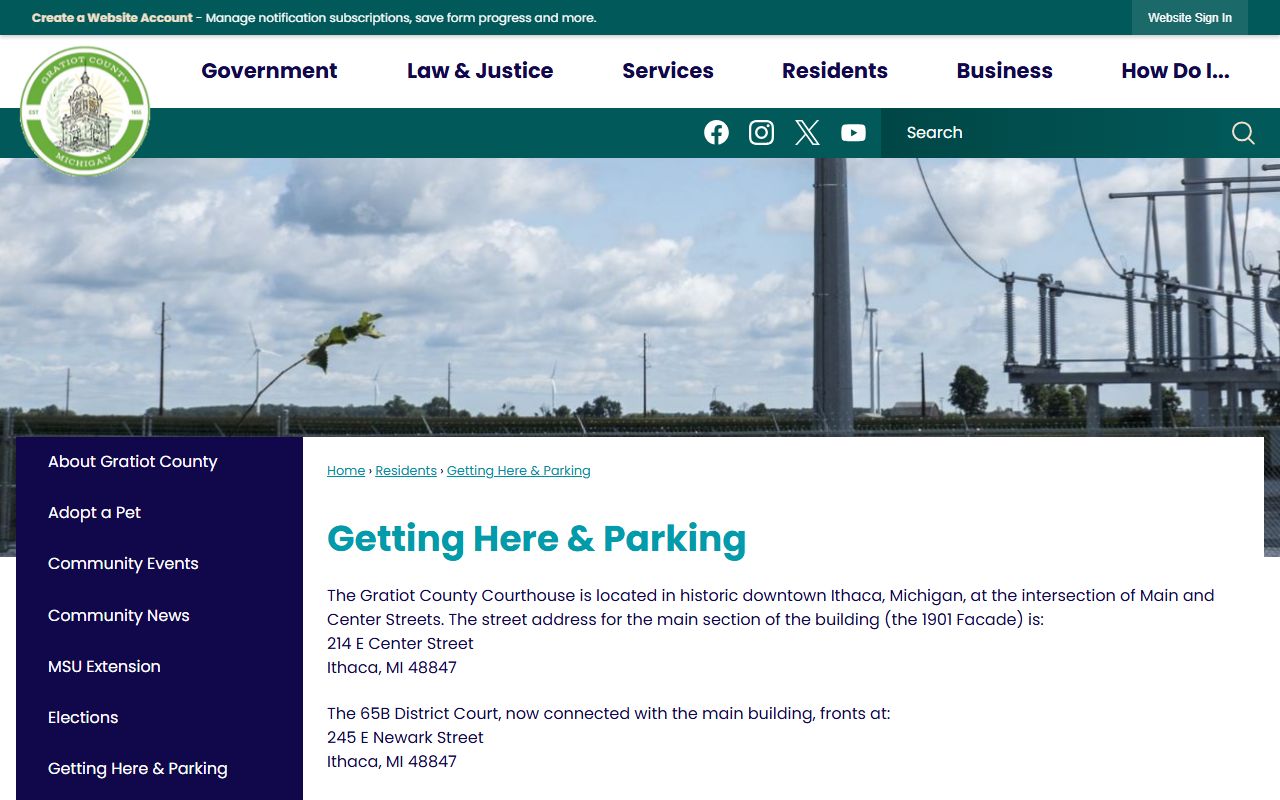
That parking and directions page lists the visitor lots, the accessible entrance, and the highway routes into town. It is the best first stop before a courthouse trip.
Types of Court Records Available in Gratiot County
The three courts together produce a broad set of public records. Circuit civil files hold complaints, answers, motions, orders, and judgments. Criminal files track charges, plea status, bond terms, and sentences. Family cases cover divorce, custody, parenting time, and support. Probate records span wills, estates, guardianships, and conservatorships. District court adds traffic, small claims, and landlord-tenant matters.
Which court produces a record depends on the case type. Felonies start in district court and move to circuit court. Misdemeanors and traffic tickets stay in district court. Estate work runs through probate. Juvenile files are handled in the county court system but are the most restricted of all.
- Criminal records - charges, arraignment, pleas, bond conditions, and sentencing terms.
- Civil records - lawsuits, small claims, landlord-tenant disputes, and civil process.
- Family and divorce records - divorce judgments, custody, support, and parenting time.
- Probate records - wills, estates, guardianships, and conservatorships.
- Traffic records - citations, civil infractions, and payment history in district court.
What Gratiot County Court Records Show
A court record is more than a verdict. It lists the case number, the assigned judge, the filing date, and the case type. It names the parties and their attorneys. It logs hearing dates and rooms, financial obligations, bond terms, and the statute or rule at issue. Docket entries then track every filing and order in date order.
The exact fields vary by record type. A traffic ticket shows a citation number, violation, and amount. A criminal file adds charges, plea, and sentence. The table below covers the fields a typical Gratiot County case record returns.
| Field | What It Shows |
|---|---|
| Case Number | The unique identifier assigned when a case is filed. |
| Filing Date | The date the case opened with the court. |
| Parties | The plaintiff, defendant, petitioner, or respondent, plus attorneys. |
| Charges / Cause | The criminal charge, civil claim, or petition at the heart of the case. |
| Disposition | The outcome of the case or charge. |
| Sentence / Judgment | Any fine, probation, custody term, or final court decision. |
Public Access Laws for Gratiot County Court Records
Court records in Michigan are open by default, but they do not run through the ordinary Freedom of Information Act. Courts sit outside the usual FOIA path, so access is governed by a court rule and the court's own policy. In Gratiot County, that means the court-record rule and a local administrative order set the terms, while the county FOIA page covers non-court records only.
A handful of statutes shape what stays open and what can be withheld. The key ones appear below with a plain-English note for each.
Key Statutes:
MCL 15.231 - Michigan's FOIA declaration, which makes public records open unless an exception applies.
MCR 8.119 - the court-record access rule, under which case files are open unless a rule or order limits them.
MCL 15.243 - the FOIA exemptions that let some records be withheld or redacted.
The practical path is steady: find the office that owns the record, use the county portal or request form, pay the listed fee, and fall back to in-person, mail, fax, or phone when the online route comes up short. A public-access terminal at the courthouse is open on weekdays for deeper lookups.
Records That Are Restricted or Confidential
Not every court record is open to the public. Juvenile files carry the tightest limits and run through juvenile-court supervision. Sealed records are hidden from ordinary search. Expunged records are set aside under state law and drop out of public view. Adoption files and mental-health proceedings are confidential, and clerks routinely redact Social Security numbers, bank details, and the names of minors.
Setting aside a conviction follows a set process. Michigan expungement is governed by MCL 780.621 and related clean-slate rules. The flow is to confirm eligibility, gather the conviction details, file in circuit court, serve the required parties, attend any hearing, and then wait for the set-aside to process through the records system. Court staff can explain the local filing steps.
Specialty Courts in Gratiot County
Gratiot County takes part in two regional treatment courts that sit inside the circuit-court system. The Mid-Michigan Regional Sobriety Court serves Gratiot, Montcalm, and Clinton counties. It grew out of the Gratiot County Recovery Court, which began in 2011. The program runs 12 to 24 months across four phases, with treatment, drug testing, peer support, community service, and regular review hearings. Stewart D. McDonald presides for Gratiot County.
The Mid-Michigan Regional Mental Health Court adds Ionia County to that regional group. It also runs 12 to 24 months across four phases and accepts both felony and misdemeanor participants. Its focus is mental-health or co-occurring treatment paired with case management and testing. Both programs take referrals through official county forms, and both aim at treatment rather than punishment.
Note: Specialty-court files include referral forms and review activity, but the underlying clinical and treatment records stay confidential.
Gratiot County Sheriff and Jail
The Gratiot County Sheriff is Tom Clark, and the office sits at 226 East Center Street in Ithaca, just east of the courthouse. The jail holds up to 70 inmates and was last renovated in 2001. Staffing runs to 13 full-time employees, a jail administrator, and temporary correctional officers. The jail division is staffed around the clock, and services include religious programs and alternative education.
Custody status is checked through the sheriff's public roster and the county inmate-account tools. The public jail roster shows who is in custody, while deposits for commissary and bond run through a separate account service. For the full booking detail and lookup steps, see the Gratiot County inmate records page, and check warrant records when an active warrant may be in play.
The county sheriff's office also handles fingerprints, gun permits, and community programs.
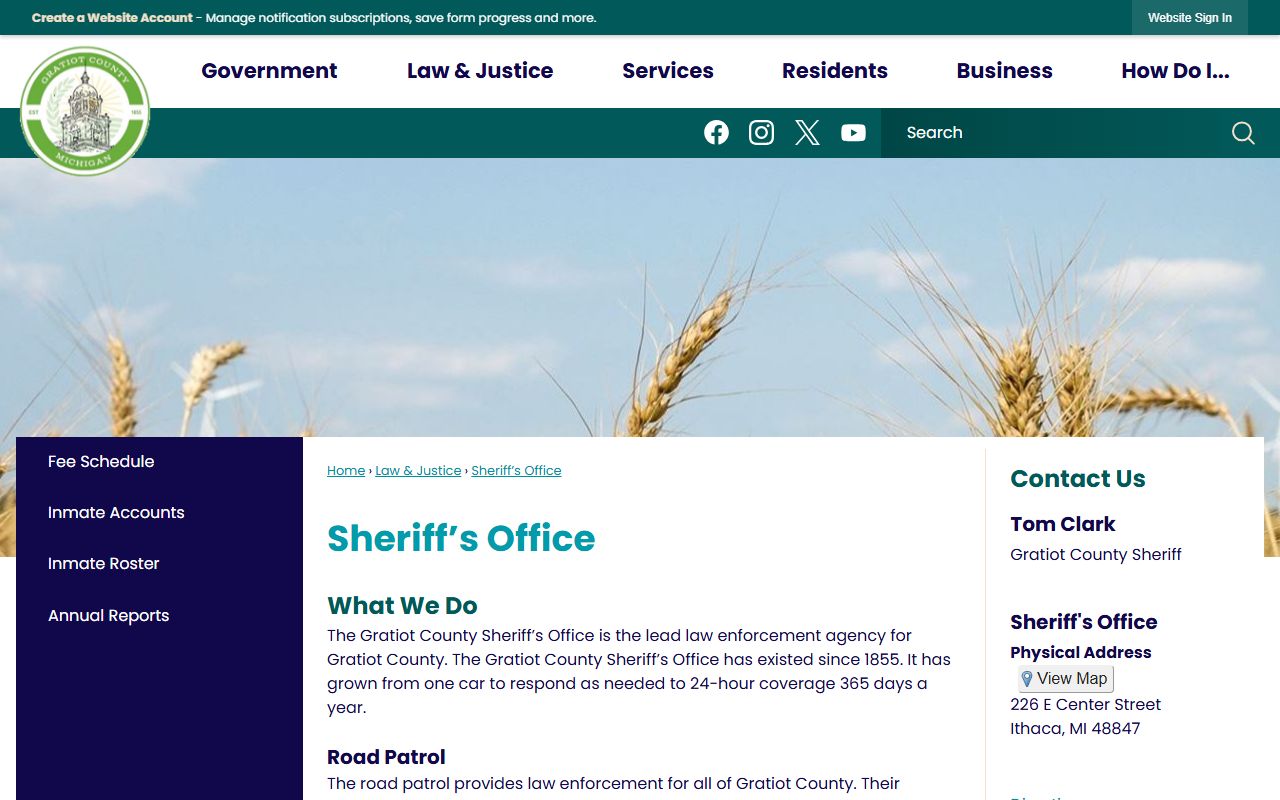
The sheriff's office page collects the jail info line, the roster link, and the inmate-account channels in one place. There is no public county warrant list, so a suspected warrant is verified by calling the court or clerk directly.
Marriage, Divorce, and Probate Court
The Gratiot County Clerk issues marriage licenses and holds certified marriage and divorce copies. A license needs a three-day wait unless waived, stays valid for 33 days, and covers marriages tied to the county filing. Divorce judgments are requested from the clerk with both party names and the divorce date. The full fee and application detail lives on the marriage and divorce records page.
Estate matters run through a separate court. The Probate Court handles deceased estates, guardianships, conservatorships, and small-estate assignments under $21,000. It keeps weekday hours and takes filings at the counter rather than through an online search portal.
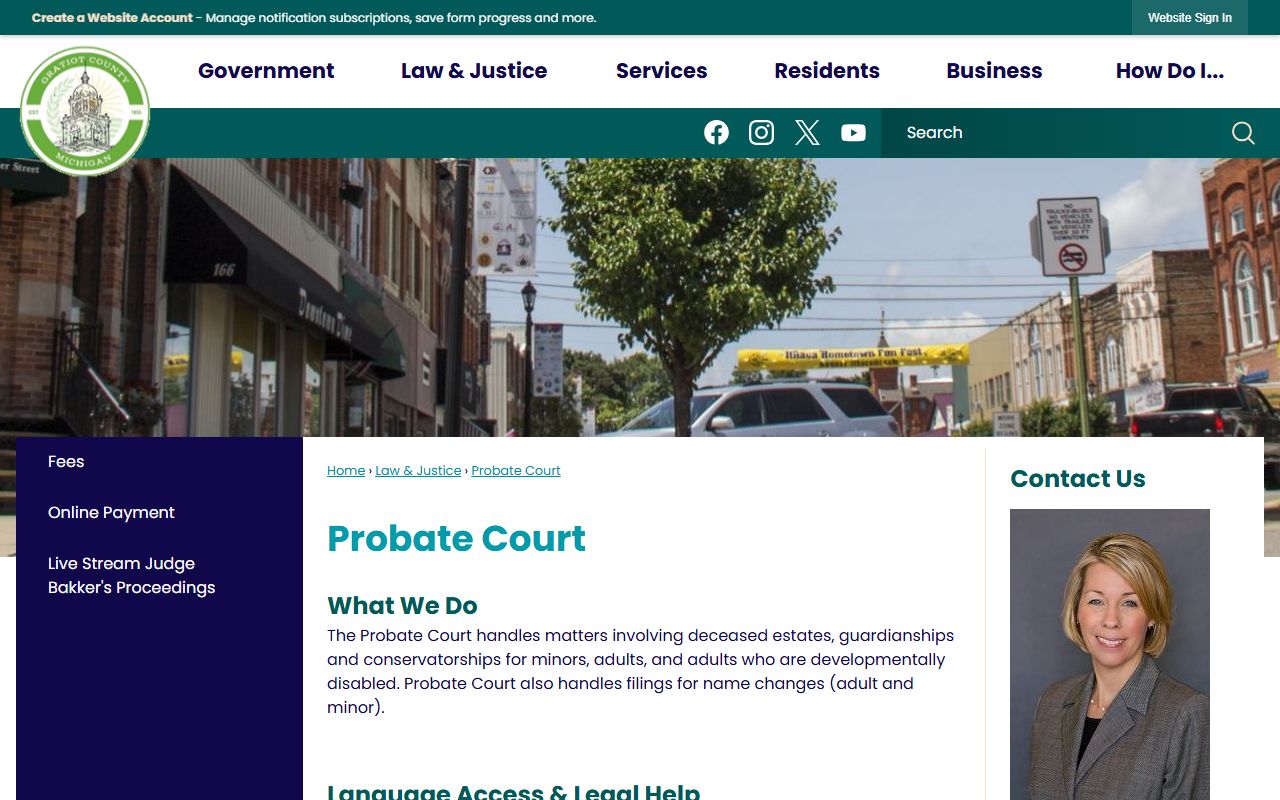
The Probate Court page lists the judge, address, and contact lines for estate and guardianship questions. A few probate terms come up again and again.
- Testator
- The person who makes a will.
- Executor
- The person named to carry out a will.
- Conservator
- A person managing finances for someone else.
- Guardian
- A person responsible for a minor or an incapacitated adult.
Gratiot County Court Records Fees
Copy and search fees at the Gratiot County Clerk are set on a published schedule. Plain copies run by the page, and certified copies add a flat certification charge. A circuit-court record search covers a ten-year window per name. Certified vital-record copies carry their own first-copy and additional-copy rates, with a reduced fee for seniors age 65 and older.
| Item | Amount |
|---|---|
| Plain copy per page | $1 |
| Certified copy | $1 per page plus $10 certification |
| Emailed copy | $4 |
| Circuit court record search (per name, 10 years) | $12 |
| First certified vital-record copy | $26 |
| Additional same-day vital copy | $12 |
Payment is taken as cash, check, money order, or card, with phone payment available too. The County Clerk page lists the office contact lines and the request forms.
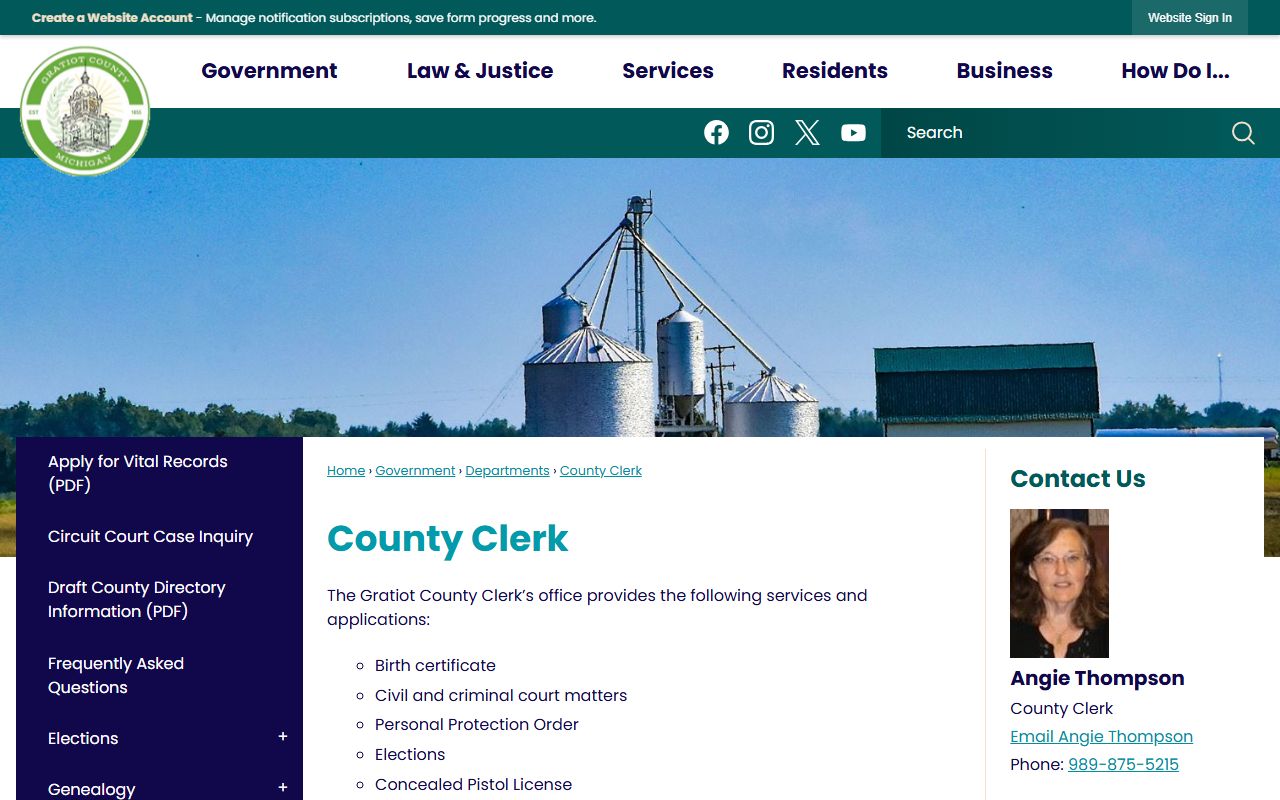
That clerk page is the hub for certified copies, record searches, and vital records. Probate filings carry their own fee list at the probate counter.
How to Interpret Gratiot County Court Records
Reading a case file starts with the difference between a charge and a conviction. A charge is what the prosecutor filed. A conviction is a finding of guilt after a plea or trial. A record can show a charge that was later dropped, reduced, or dismissed, so the disposition line matters more than the opening charge. A dismissal ends a case, and a note of prejudice tells you whether it can be refiled.
Docket entries carry the case history in short, dated lines. They log motions, orders, hearings, and continuances. Each entry may cite a statute or court rule that explains the action. When a term is unclear, the clerk or court staff can point to what a code or abbreviation means before you rely on it.
Accuracy and Record Limitations
Online court data is a snapshot, not the last word. The district court calendar refreshes on a set cycle and leaves out non-public cases. Some files were never scanned, and pre-1996 matters may need a manual index-book review. A record can lag behind a recent filing, and attorney views sometimes differ from public views.
For anything that carries legal weight, the certified paper copy from the clerk is the reliable source. Uncertified online printouts are not accepted in court. When a detail looks wrong or incomplete, the office that owns the record is the place to correct it.
Note: Confirm any name, date, or disposition with the originating court or clerk before relying on an online record for a legal or personal decision.
History of Gratiot County Courts
Gratiot County was settled in the mid-1800s and named for Army Captain Charles Gratiot. The county seat was set in Ithaca in 1856, and the sheriff's office traces back to 1855. The current courthouse is a Classical Revival landmark with a 1901 facade, and it still anchors historic downtown Ithaca.
The county's court mix reflects Michigan's modern trial-court model. Circuit, district, and probate courts each carry a defined role, and the district court now shares a connected building with the main courthouse. Older genealogy indexes for births, deaths, and marriages remain on file at the clerk's office, a reminder that paper records still sit beside today's online tools.
Frequently Asked Questions
How do I search Gratiot County court records online?
Start with the Michigan MiCOURT case search, which reaches court cases across the state, then use the county Find hub if you are unsure which court holds a file. The 65B District Court posts a live calendar for daily hearings and keeps a public terminal at the courthouse. Traffic tickets are reviewed through Court Innovations and searched through the state eTix portal. Older or non-digitized files are checked by phone, fax, email, mail, or in person.
Where are Gratiot County circuit court cases filed?
All civil, criminal, and family cases for the 29th Circuit Court are filed with the Gratiot County Clerk. Case information and hearing scheduling run through the circuit-court clerk line. The clerk counter is the first local stop before any broader statewide search, and it is also where certified circuit-court copies are requested.
Can I look up a Gratiot County inmate?
Yes. The sheriff's office keeps a public jail roster that shows who is in custody at the county jail. Deposits for commissary and bond run through a separate account service. Full booking detail, roster steps, and related state tools appear on the Gratiot County inmate records page.
Does Gratiot County post a public warrant list?
No public county warrant list exists, and the sheriff's page does not publish one. A suspected bench warrant is most likely tracked inside a district-court or circuit-court case file. Verify status by calling the district court, the circuit court, or the clerk, and see the warrant records page for the full set of channels.
How much does a certified court record copy cost?
Certified copies run $1 per page plus a $10 certification fee. A circuit-court record search covers a ten-year window at $12 per name. Certified vital-record copies are $26 for the first copy and $12 for each additional same-day copy, with a lower rate for seniors 65 and older. Payment is taken as cash, check, money order, or card.
How do I get a Gratiot County marriage or divorce record?
Both come from the county clerk. Marriage licenses are issued to applicants who meet the age and residency rules, with a three-day wait unless waived. Divorce judgments are requested in writing with both party names and the divorce date. The marriage and divorce records page carries the full fee and application detail.
Are Gratiot County court records covered by FOIA?
Court records sit outside the ordinary Freedom of Information Act. Access is governed by the Michigan court-record rule and a local administrative order rather than a generic county records page. The county FOIA process is the right fallback for non-court county records, and it is not a substitute for the court-record rule.