
What Is a Gratiot County Court Docket
A docket is a court's official log of a case. Each line, called a docket entry, marks one event. The clerk adds an entry when a paper is filed, a hearing is set, a motion is heard, or a judge signs an order. Read in order, the entries tell the story of a case from the first filing to the final judgment. In Gratiot County the docket is the quickest way to see a case's status and its next hearing date.
A docket is not the full case file. It lists what happened and when, but it does not hold the text of every motion, exhibit, or order. Think of the docket as the table of contents and the case file as the pages behind it. Court dockets are short by design. They let staff, attorneys, and the public follow a case without pulling the whole file.
Dockets look a little different at each court level. A district court docket may center on arraignments, pretrial dates, and civil infraction hearings. A circuit court docket tends to run longer, since felony and family cases move through many stages. Probate dockets track estates, guardianships, and conservatorship reviews. The event types change, but the idea stays the same across every Gratiot County court.
How to Find Gratiot County Dockets Online
The starting point for most people is the statewide case system. The Michigan Trial Court Case Search, known as MiCOURT case search, lets you look up cases by party name, case number, or attorney across participating courts. It is the broadest single tool for finding a Gratiot County case and stepping into its docket. The county's own pages route users to this state case database when no narrower portal fits.
For same-day district hearings, a different tool works better. The 65B District Court posts a live calendar that lists who is scheduled and when. For circuit civil, family, and felony matters, the county clerk's office is the first local stop for case and scheduling information. Each channel covers a different slice, so the court level decides which one you use.
- Pick the court level first: circuit for civil, family, and felony cases, district for misdemeanor and traffic, probate for estates and guardianships.
- Open MiCOURT case search for a statewide lookup when the county page does not point to a more specific portal.
- Enter a party name or a case number, then add an attorney or bar number if you have one.
- Open the matching case and read its docket entries from the earliest date forward.
- For a same-day district hearing, use the live 65B District Court calendar instead of the case search.
- If a case is older or does not appear online, request a records check from the clerk by phone, mail, fax, or in person.
Note: Pre-1996 Gratiot County files often live in manual index books, so those dockets may need staff to pull them by hand.
The Live 65B District Court Calendar
The 65B District Court runs the most public-facing docket tool in Gratiot County. It is a live court calendar that shows the day's scheduled hearings. The calendar refreshes every 30 minutes, so it stays close to real time as cases are added, moved, or resolved. That makes it a strong choice for anyone checking a hearing that is set for the same day.
The county explains the setup on its Court-Calendar page, which describes the docket as an alphabetical defendant listing sorted by date and time. You browse the day, find the name, and read the scheduled slot. The public district calendar is the live feed itself. One limit matters: the calendar omits non-public cases, so sealed and confidential matters never show up there.
The county's Court-Calendar page walks through what the live docket shows and links to the public calendar feed, as seen in the Gratiot County district court calendar overview.
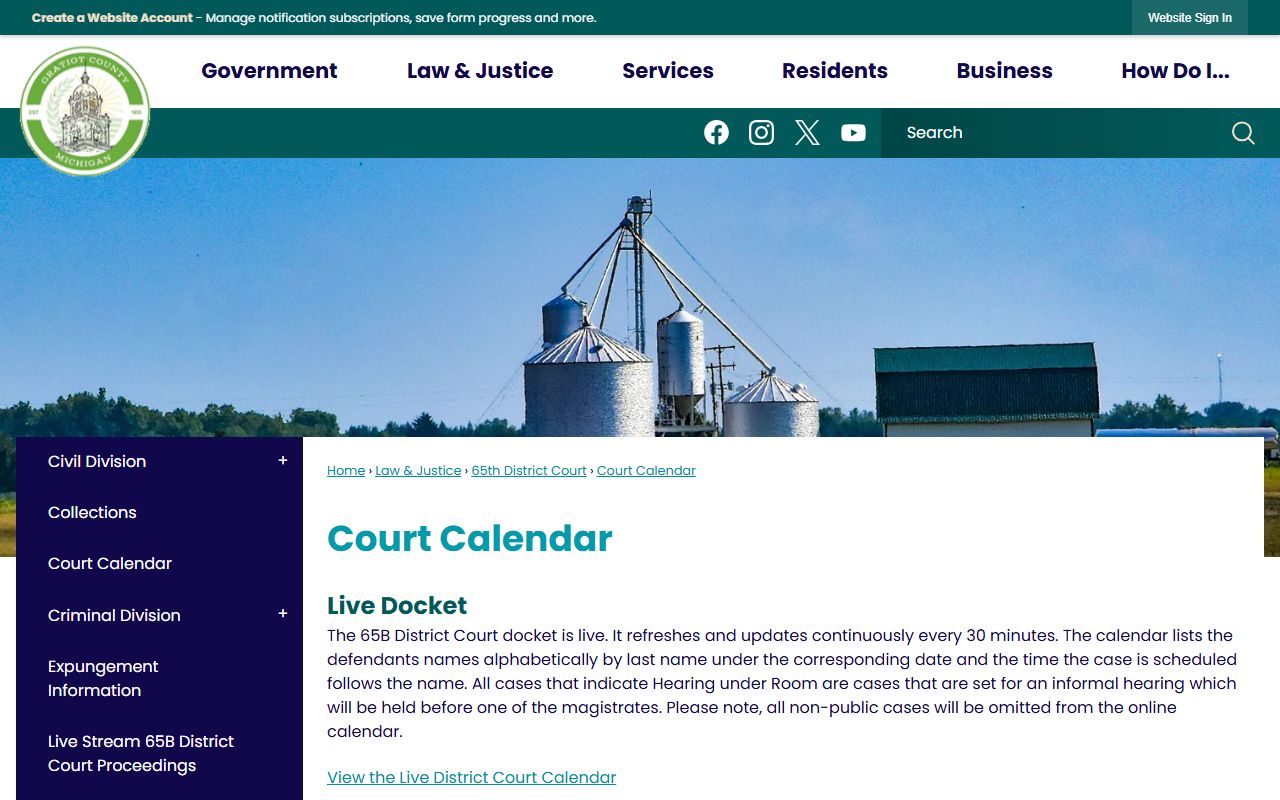
That page is the plain-language entry point for the live docket, and it makes clear the feed is a quick daily snapshot rather than a full case history. For deeper lookups, the district court also keeps a public-access terminal at its counter during posted weekday hours.
Fields in a Gratiot County Docket Entry
A single docket entry packs several facts into one line. Once you know the fields, the log reads quickly. The table below breaks down the pieces you are likely to see in a Gratiot County court record and what each one tells you.
| Field | What It Shows |
|---|---|
| Case Number | The unique ID the court assigns to the case. |
| Court | The court holding the case, such as circuit, district, or probate. |
| Judge | The judge assigned to hear the matter. |
| Filing Date | The date the case or document was filed. |
| Case Type | The category, such as civil, criminal, family, or traffic. |
| Status or Disposition | Whether the case is open, closed, or resolved, and how. |
| Party Names | The plaintiff, defendant, petitioner, or respondent. |
| Attorney Names | Counsel of record for each side. |
| Hearing Dates and Rooms | Scheduled appearances and where they are held. |
| Financial Obligations | Fines, costs, restitution, or other amounts owed. |
| Bond Terms | The bond amount and any release conditions. |
| Statute or Rule Citation | The law or court rule tied to the charge or filing. |
| Docket Entries and Order History | The dated list of events and signed orders. |
Not every field appears in every case. A traffic file may show a citation and amount but no bond. A felony docket may run for pages with many hearing dates and orders. The mix depends on the case type and how far it has moved.
Courts That Publish Gratiot County Dockets
Three trial courts handle cases in Gratiot County, and each keeps its own dockets. Michigan uses a District Court, Circuit Court, Michigan Court of Appeals, and Michigan Supreme Court structure, with no municipal or justice court in the mix. Felonies begin in district court and bind over to circuit court, so a single case can appear on more than one court's docket over time.
The state's overview of the trial-court system explains how these courts fit together, shown on the Michigan trial courts page.
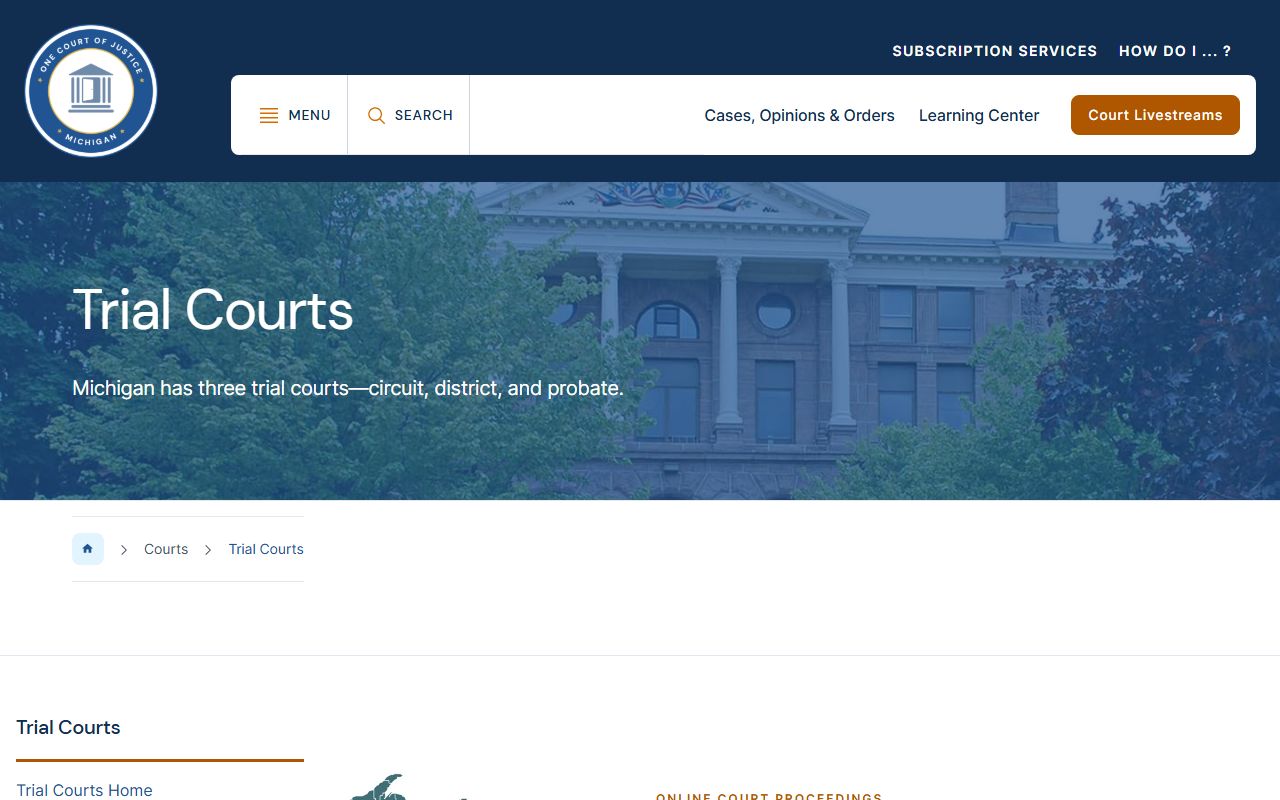
That overview sets the frame for which court owns which docket in the county. The list below sums up what each court covers and how its docket tends to appear.
- 29th Circuit Court: civil, criminal, family, and felony matters after bind-over, plus appeals from lower courts.
- 65B District Court: misdemeanors, traffic, civil infractions, small claims, and felony arraignments and preliminary exams.
- Probate Court: estates, guardianships, conservatorships, name changes, and related probate filings.
The district court is the only one with a live public calendar. Circuit and probate scheduling runs through the clerk and the statewide case system rather than a rolling daily feed.
Circuit Court Scheduling and Motion Days
Circuit court dockets in Gratiot County do not sit on a live 30-minute feed. Instead, all circuit civil, criminal, and family filings run through the Gratiot County Clerk, and case and hearing scheduling is handled by the circuit-court clerk line at 989-875-5224. For a circuit matter, the clerk's office is the first local stop before any broader state search.
The county lays out how hearings and motion days are set on its Scheduling-Information page.
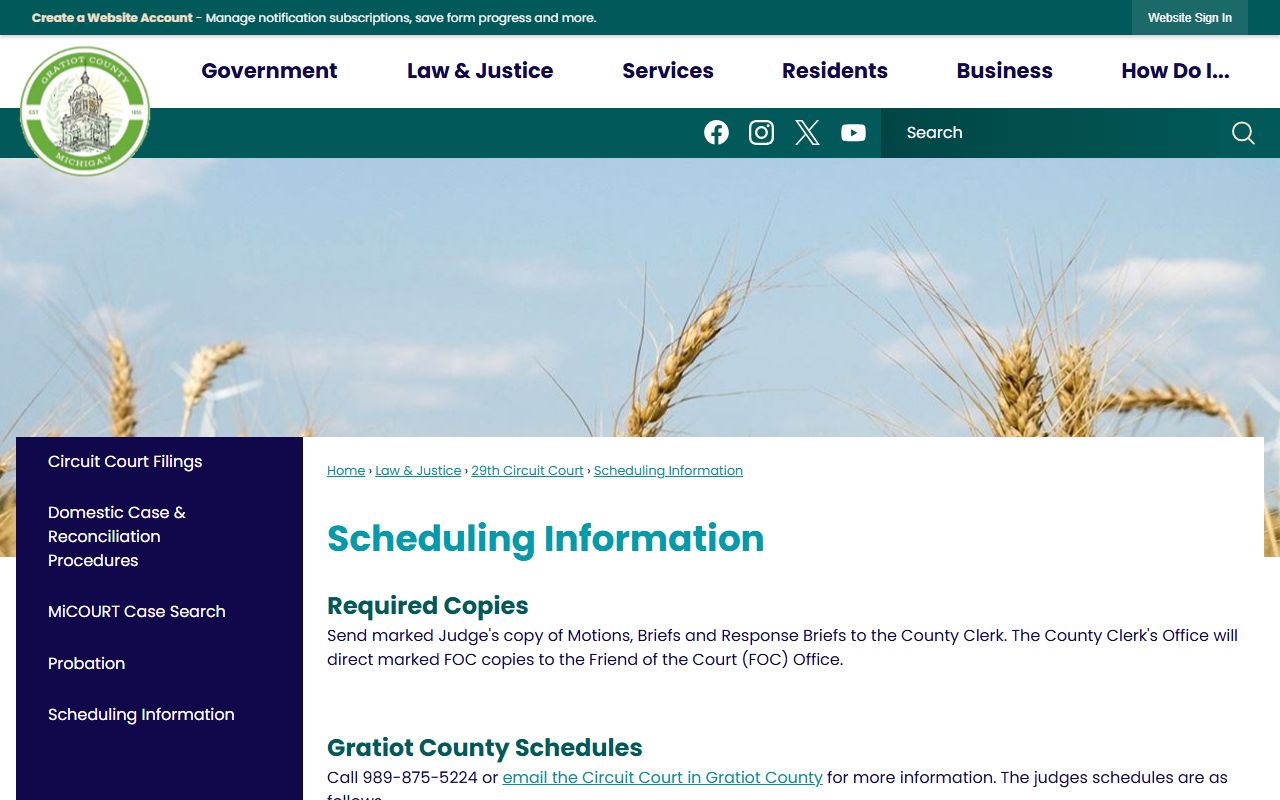
That page is the place to confirm how a motion gets on the calendar and when the court hears it. Because these dockets are not published as a rolling daily list, calling the clerk or checking the statewide case search is the reliable way to confirm a circuit hearing date.
Docket vs. Full Case Record
The docket and the full case record are not the same thing, and mixing them up leads to wasted trips. A docket is a list of dated events. The full case record is the stack of documents behind those events, including the text of each motion, exhibit, and order. One tells you what happened. The other shows you the actual papers.
The comparison below lays out where the two part ways, so you know which one answers your question.
| Docket | Full Case Record | |
|---|---|---|
| Content | Dated list of events and entries | Full text of filings, exhibits, and orders |
| Format | Short one-line entries | Complete documents and forms |
| Access | Often online or on the live calendar | May need a records request, fee, or counter visit |
| Best Use | Track status and next hearing | Legal review, copies, and evidence |
For a certified copy of anything in the file, the docket alone will not do. You request the document from the clerk, using the county request form or the listed copy fee. The docket points you to the entry, and the clerk supplies the paper.
How to Read a Gratiot County Docket
Dockets lean on short legal terms, and a few definitions make the whole log clearer. The words below appear across circuit, district, and probate dockets in the county. Learn these, and most entries read plainly.
- Arraignment
- The first criminal appearance, where the charges are read.
- Bind-over
- Transfer of a felony case from district court to circuit court.
- Motion
- A request asking the court to take some action.
- Continuance
- A postponement that moves a hearing to a later date.
- Disposition
- The outcome of the case or a single charge.
- Bond
- Money or terms set for a defendant's release.
Disposition entries carry a few common tags. A dismissal ends the case. With prejudice means it cannot be refiled, while without prejudice leaves the door open. Personal recognizance means release without cash security when conditions are met. Reading the disposition line tells you whether a case is truly closed.
When an entry does not make sense, the clerk can explain what a code or abbreviation means before you pay for any copy. Records staff walk through what is available and how to get it. For the full stages behind these entries, the county criminal court records hold the charges, pleas, and sentencing detail.