
Criminal Court Records in Gratiot County
A criminal court record is the official case file a court opens when a person is formally charged with a crime. In Gratiot County, the County Clerk keeps the circuit-court criminal files, while the 65B District Court keeps its own criminal files. The file starts with the charging document and grows with every filing after it. Bond papers, plea forms, motions, orders, and the final judgment all land in the same case folder. Court staff log each event on the docket, so the record reads like a timeline of the case from the first appearance forward.
Two trial courts handle criminal matters in the county. The 65B District Court hears misdemeanors from arraignment through sentencing, and it takes the first steps in every felony. The 29th Circuit Court handles felony cases after they bind over from district court. A felony starts in district court with an arraignment and a preliminary exam, then moves up to circuit court for trial or plea. The county prosecutor decides what to charge and carries the case for the state. For a closer look at the charges themselves, the Gratiot County arrest and court charge records page breaks down how each count is filed and tracked.
The office of the prosecuting attorney is the source of every criminal complaint in the county. A lead-in to the local prosecutor is the Gratiot County Prosecuting Attorney office page, run by Laura Bever at 989-875-5236.
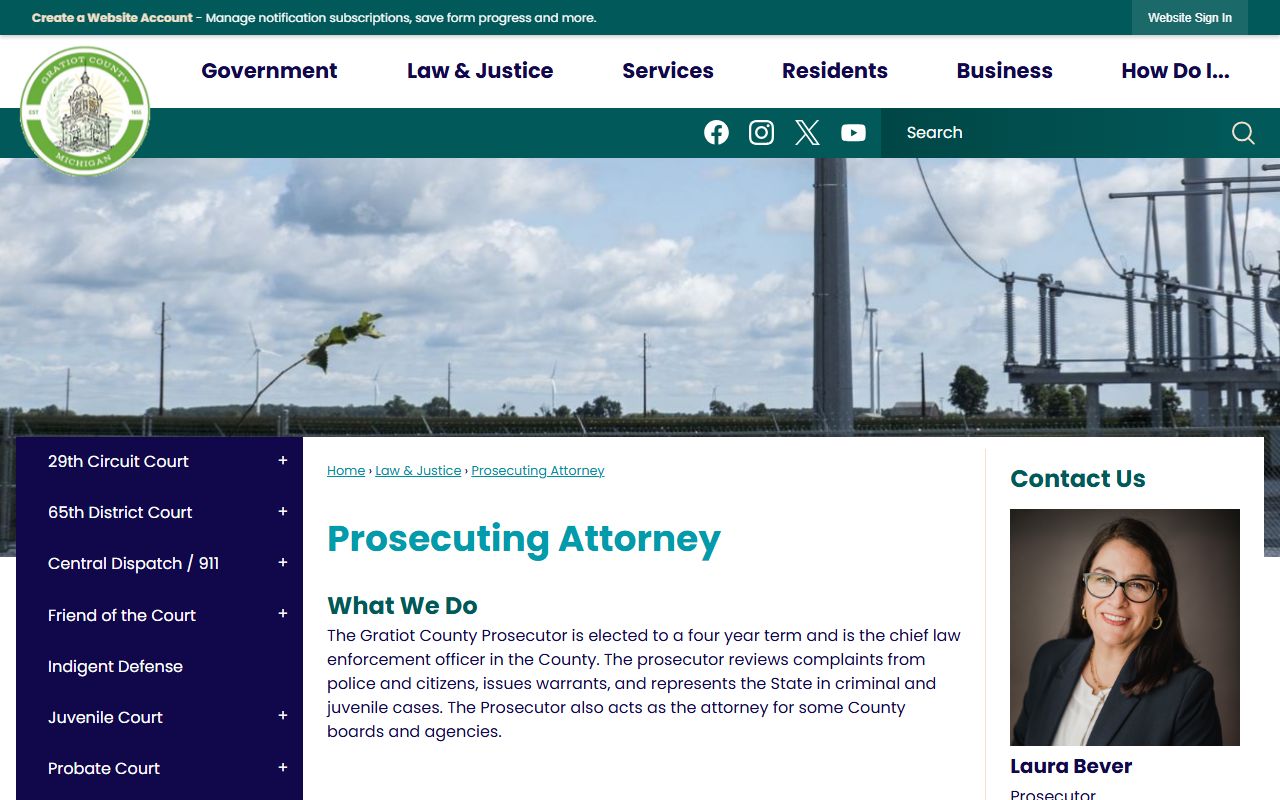
The prosecutor's charging choices set the shape of the record that follows. The counts filed there become the first entries in the court case file.
How to Search Gratiot County Criminal Court Records
The Michigan Trial Courts run a statewide case-search tool called MiCOURT. It is the main online starting point for a criminal court records lookup. The tool reaches many trial courts and lets a user search by party name or case number. Some older or non-digitized files will not show there, so the clerk counter stays a needed backup. The county clerk page also links to the circuit-court case inquiry for local cases.
- Open the MiCOURT case-search page and pick the party-name or case-number field.
- Enter the defendant name or the case number, then run the search.
- Narrow the results by court, case type, and filing date to find the right file.
- Open the case to read the docket, the charges, and the disposition.
- Request a certified copy from the County Clerk if the record is needed for court or another official use.
When a file is not online, the County Clerk can run a record check. The clerk charges $12 per name for a 10-year circuit-court record search. Requests can be made in person, by phone, by fax, by email, or by mailed written request. For records held only in district court, the 65B District Court public terminal and staff handle lookups. Pre-1996 matters may still need a manual index-book review.
Stages of a Gratiot County Criminal Case
A criminal case moves through set stages, and each stage adds an entry to the record. The path depends on whether the charge is a misdemeanor or a felony. Misdemeanors stay in district court from start to finish. Felonies begin in district court, then bind over to circuit court once the evidence clears the preliminary exam. Reading the docket in order shows how far a case has moved and what the court did at each step.
Case flow: Charges Filed › Arraignment (65B District Court) › Preliminary Exam or Pretrial › Bind-Over to 29th Circuit Court (felonies) › Plea or Trial › Disposition › Sentencing
| Stage | What Happens |
|---|---|
| Arraignment | The first court appearance in the 65B District Court, where the charges are read and bond is set. |
| Preliminary Exam / Pretrial | The district court tests felony evidence at a preliminary exam; misdemeanor cases move to pretrial talks and motions. |
| Plea or Trial | The defendant pleads, or the case goes to trial in the 29th Circuit Court for felonies or the district court for misdemeanors. |
| Sentencing | The judge sets the penalty, which may include jail, fines, costs, restitution, or probation. |
Note: A felony that binds over shifts from the district-court file to the circuit-court file, so a full history may sit in two case numbers.
What a Gratiot County Criminal Court Record Shows
A criminal court file holds the same core fields found in most Michigan case records. It names the parties, lists the charges, and logs every date and order. The record ties each filing to a statute or court-rule citation, so a reader can see the legal basis for each count. Financial terms, bond conditions, and hearing rooms also appear. Taken together, the fields let a reader follow the case without guessing.
| Field | What It Shows |
|---|---|
| Case Number | The unique number the court assigns to track the file and all its entries. |
| Defendant | The person charged, with attorney names for both sides where listed. |
| Charges | Each count as filed, with the statute cited and the offense level. |
| Plea | How the defendant answered the charge, such as guilty, not guilty, or no contest. |
| Disposition | The outcome of each charge, such as convicted, dismissed, or acquitted. |
| Sentence | The penalty set at sentencing, including jail, probation, fines, costs, and restitution. |
Public files can hide some data. Courts redact Social Security numbers, bank account numbers, and information that could name a minor. Sealed content and non-public cases do not appear on the live county calendar. Staff can explain what is open before a paid copy request goes in.
Charges vs. Convictions
Being charged is not the same as being convicted. A criminal court record can show charges that were dropped, dismissed, reduced, or that ended in an acquittal. A charge is only an accusation the state must still prove. A conviction is the final finding of guilt by plea or verdict. Reading the disposition line tells which one applies. A file with an open charge and no disposition means the case is not yet done.
| Charge | Conviction | |
|---|---|---|
| Stage | Accusation at the start of a case | Verdict or plea at the end |
| Burden of Proof | Probable cause to file | Beyond a reasonable doubt |
| Meaning | The state claims an offense | The court finds guilt |
| Public Record | Yes | Yes |
Reading Dispositions and Sentences
The disposition is the outcome the court records for each charge. Common entries include guilty, not guilty, dismissed, and no contest. Some cases end with a deferred outcome, where a plea is held back if the person meets set terms. The sentence follows a conviction and lists the exact penalty. A sentence in Gratiot County may mix jail time, fines, court costs, restitution to victims, and probation. Probation puts a person under supervision in the community instead of, or after, time in jail.
The circuit court runs a probation office that supervises many sentenced defendants. A useful reference is the Gratiot County Probation Division page, which lists the office contact and hours.
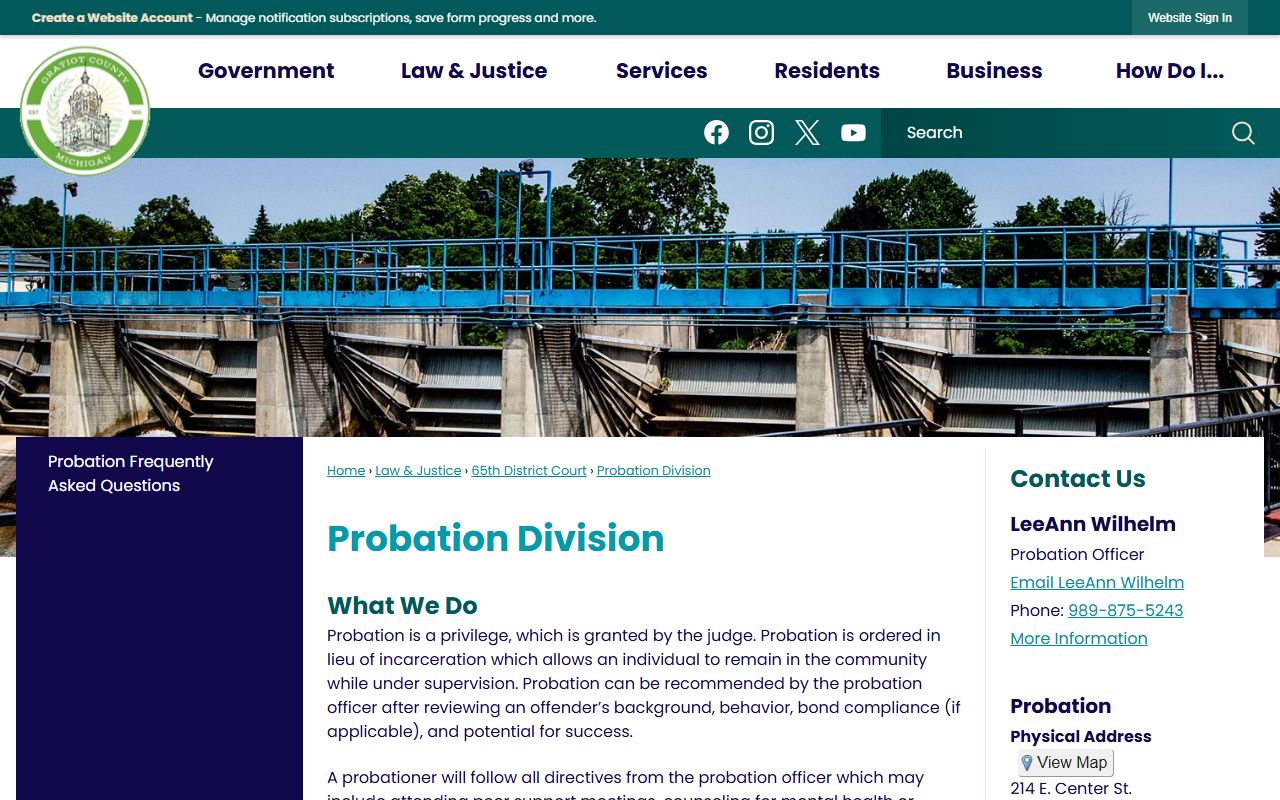
Probation terms and any violations show up in the case file as new entries. That is why a record can grow long after the sentencing date. Several plain-language terms recur across these records:
- Arraignment
- The first criminal-court appearance, where the charges are read.
- Preliminary examination
- A district-court hearing that tests whether felony evidence is strong enough to proceed.
- Bind-over
- The transfer of a felony case from district court up to circuit court.
- Disposition
- The outcome of a case or a single charge.
- Restitution
- Money the defendant pays to a victim as ordered by the court.
- Probation
- A supervised sentence served in the community under set conditions.
Sealed vs. Expunged Records
Not every criminal record stays open forever. Michigan law lets some people limit or remove a conviction from public view. A sealed record is hidden from an ordinary public search but still exists. An expunged, or set-aside, record is treated as though the conviction never happened. The two paths differ in how far the record disappears and who can still reach it. Michigan expungement runs under MCL 780.621, which lets eligible convictions be set aside through a court filing.
An overview of the statute sits on the Michigan expungement law page maintained by the state legislature.
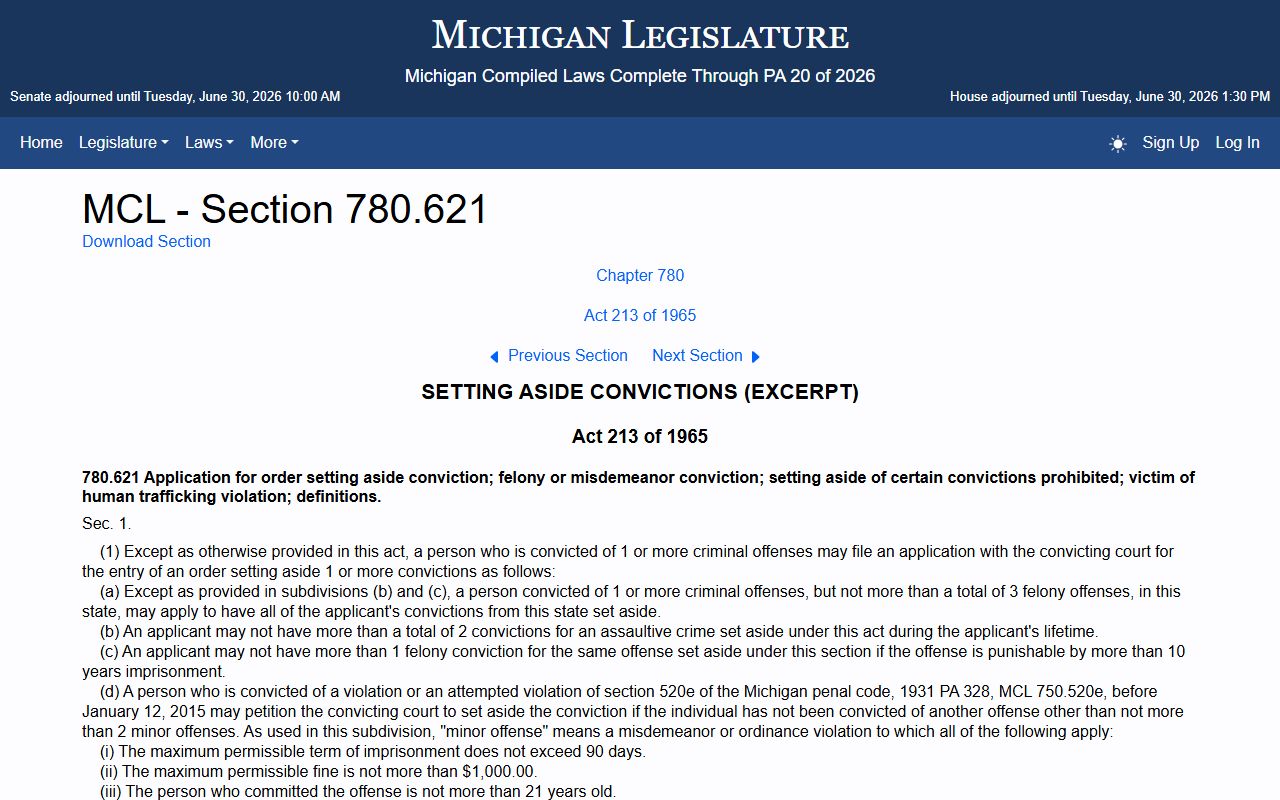
That page lays out who may ask a court to set aside a conviction. The set-aside must be filed in circuit court, with the required parties served before any hearing.
| Sealed | Expunged | |
|---|---|---|
| Visibility | Hidden from public search | Set aside and treated as never existed |
| Law Enforcement | Limited access remains | Very limited, kept for narrow legal uses |
| Michigan Path | Court order limits access under the court rule | Set-aside petition under MCL 780.621 |
Michigan also runs an automatic clean-slate system. Under MCL 780.621g, some convictions are set aside automatically after a waiting period, with no filing needed. A person can still file the standard petition to clear a record sooner. The county does not publish a special Gratiot-only expungement fee, so the statute pages and court staff cover eligibility and local filing steps.
Public Access to Criminal Court Records
Criminal case files in Michigan are open to the public unless a rule or order limits access. Courts are not a normal Freedom of Information Act office, so court files follow a court rule instead of the general public-records law. That rule sets who may view a file and how the clerk shares copies. Older files and certified copies are handled at the clerk counter, while newer files often appear through the state case-search tool.
Key Statutes:
Michigan MCL 15.243 - Lists the exemptions that let a court or office withhold or redact certain records even after a request.
MCR 8.119 - The Michigan court-record access rule; case files are open unless a rule or court order limits the access.
For everyday requests, the practical path is simple. Find the office that owns the file, use the online portal or a request form, pay the listed copy or search fee, then fall back to in-person, mail, fax, email, or phone when the online route comes up short. For the wider set of civil and court files beyond the criminal track, the Gratiot County court records page covers the full request process.
Background Check Considerations
A criminal court lookup and a formal background check are not the same thing. A quick search of a case file tells what a single court did in one matter. A formal background check pulls a broader criminal history and follows federal rules when used for hiring, housing, or credit. A statewide record search through the County Clerk covers circuit-court files for a set fee, but it is not a certified statewide criminal history. People who need a full history for legal use should rely on the proper state channel.
Important: This site is not an FCRA-regulated consumer reporting agency, and its records may not be used for employment, tenant, credit, or insurance screening.
Restricted Criminal Court Records in Gratiot County
Some criminal records sit outside ordinary public view. Juvenile cases are the most restricted of the common county records, and they run through the juvenile-court supervision track. Sealed cases stay hidden from a routine search, and expunged cases are removed from public visibility once the set-aside processes. Ongoing matters that involve minors or sensitive facts may show only limited case-level data. Adoption records and mental-health proceedings are also kept confidential.
The automatic set-aside law shapes what stays visible over time. A quick reference is the Michigan automatic set-aside statute page from the state legislature.
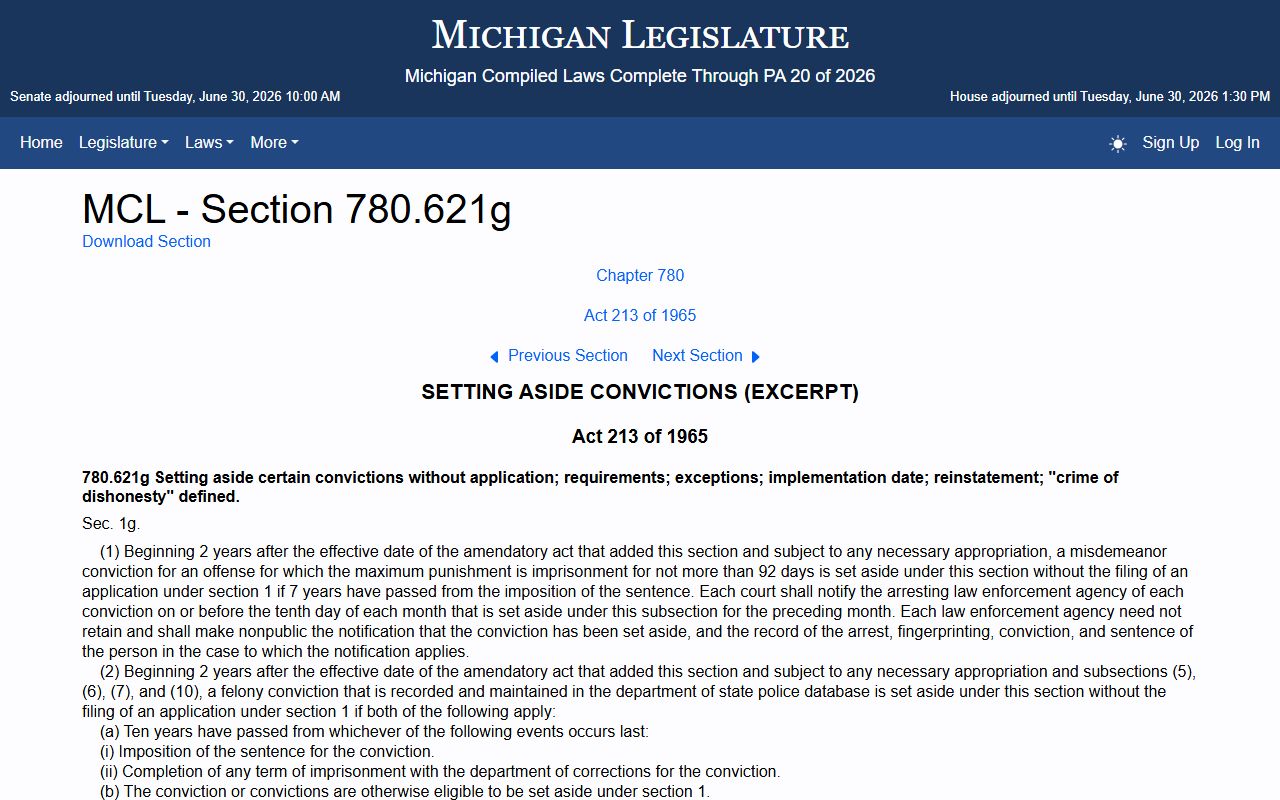
That statute is why an old conviction may vanish from a public search without any filing. When a record seems missing, the County Clerk or the court staff can confirm whether it was sealed, set aside, or simply never digitized. Note: A file that is closed to the public may still be reachable by a party to the case or by law enforcement under the court rule.