
Gratiot County Circuit Court Overview
The 29th Circuit Court is the general trial court for Gratiot County. It sits at 214 E Center Street in Ithaca, inside the historic downtown courthouse. The clerk and scheduling line for circuit matters is 989-875-5224. Two judges hear the docket. They are Cori E. Barkman and Shannon L.W. Schlegel. Their courtrooms carry the heaviest civil and criminal cases in the county.
Circuit courts in Michigan handle the big matters. That means felony criminal cases after a bind-over, civil suits over larger dollar amounts, and the family division work such as divorce, custody, and child support. The court also hears appeals that come up from the district court and from many county agencies. In Gratiot County the same court reviews those lower rulings before any case moves to the state appellate level.
Michigan groups counties into judicial circuits. Gratiot County makes up the 29th Circuit on its own. That single-county setup keeps the local docket close to home. Records for these cases live with the county clerk, not a separate court clerk, which shapes how filings and searches work across the county.
Gratiot County Trial Court Directory
Three trial courts serve Gratiot County day to day. The Circuit Court takes the major civil, criminal, and family cases. The 65B District Court handles the high-volume work like traffic, misdemeanors, and small claims. The Probate Court manages estates, guardianships, and name changes. Michigan has no municipal court or justice-of-the-peace court, so these three cover the full local trial load. The table below lists each court with its case types, address, and phone.
| Court | Case Types | Address | Phone |
|---|---|---|---|
| 29th Circuit Court | Felonies after bind-over, larger civil suits, divorce and family, appeals from lower courts | 214 E Center Street, Ithaca, MI 48847 | 989-875-5224 |
| 65B District Court | Misdemeanors, traffic, civil infractions, small claims, felony arraignments and preliminary exams | 245 E Newark Street, Ithaca, MI 48847 | 989-875-5240 |
| Probate Court | Estates, guardianships, conservatorships, name changes, related probate filings | 214 E Center Street, Ithaca, MI 48847 | 989-875-5231 |
All three sit in the same downtown Ithaca complex. The district court fronts Newark Street and connects to the main courthouse. Free visitor parking and a west-side accessible entrance serve the whole campus.
Circuit Court vs District Court vs Probate Court
Each Gratiot County court has its own lane. The Circuit Court is the trial court of general jurisdiction, so it takes the serious and higher-stakes cases. The District Court is the court people meet most often, since it handles tickets, minor crimes, and smaller disputes. The Probate Court is a specialized court built for estates and protective cases. The comparison below shows how they divide the work.
| Circuit Court | District Court | Probate Court | |
|---|---|---|---|
| Civil Cases | Larger civil suits and appeals | Small claims and lower-dollar civil | Estate and civil probate actions |
| Criminal Jurisdiction | Felonies after bind-over | Misdemeanors, felony arraignment and exam | None |
| Family and Related | Divorce, custody, child support | Landlord-tenant, civil infractions | Guardianship, conservatorship, name change |
| Where Filed | County Clerk's Office | District Court counter or MiFILE | Probate Court office |
Felony cases cross these lines. A felony starts in the District Court and can bind over to the Circuit Court. That handoff is why one criminal matter may show up in two court files.
How a Case Moves Through the System
Cases in Gratiot County follow a set path up the ladder. A criminal case begins in the District Court, where a defendant is arraigned and a felony gets a preliminary exam. If the judge finds enough proof, the felony binds over to the Circuit Court for trial and sentencing. Civil disputes over larger amounts and all divorce filings start in the Circuit Court from the outset.
Court flow: District Court › Circuit Court › Michigan Court of Appeals › Michigan Supreme Court
Appeals move in one direction. A party who loses in the Circuit Court may ask the Michigan trial court system's next level, the Michigan Court of Appeals, to review the ruling. The Michigan Supreme Court sits at the top and hears a smaller set of those appeals. Most Gratiot County cases end long before they reach either appellate court.
Note: A felony can appear in both district and circuit files, so a full history often means checking the case at more than one court level.
Filing Circuit Court Cases With the County Clerk
Circuit-court filings in Gratiot County run through the County Clerk. All civil, criminal, and family-division circuit cases are filed in the County Clerk's Office, not at a separate court desk. The clerk is Angie Thompson, and the office sits at 214 E Center Street, Suite 16, in Ithaca. The main clerk line is 989-875-5215. Circuit case information and hearing dates go through the circuit clerk line at 989-875-5224.
Motions and briefs take the same route. A party files the paper with the county clerk, who forwards it for the judge as needed. Motion-day scheduling is set through the circuit court, and the county publishes filing and hearing guidance on its scheduling page. That page explains how motion day works and how a filing flows from the clerk to the court.
Payments for circuit matters have an online option too. The lead-in to the county payment tools appears on the state Michigan court ePAY portal and the county Pay For hub. The image below shows the ePAY landing page used for court payments across the state.
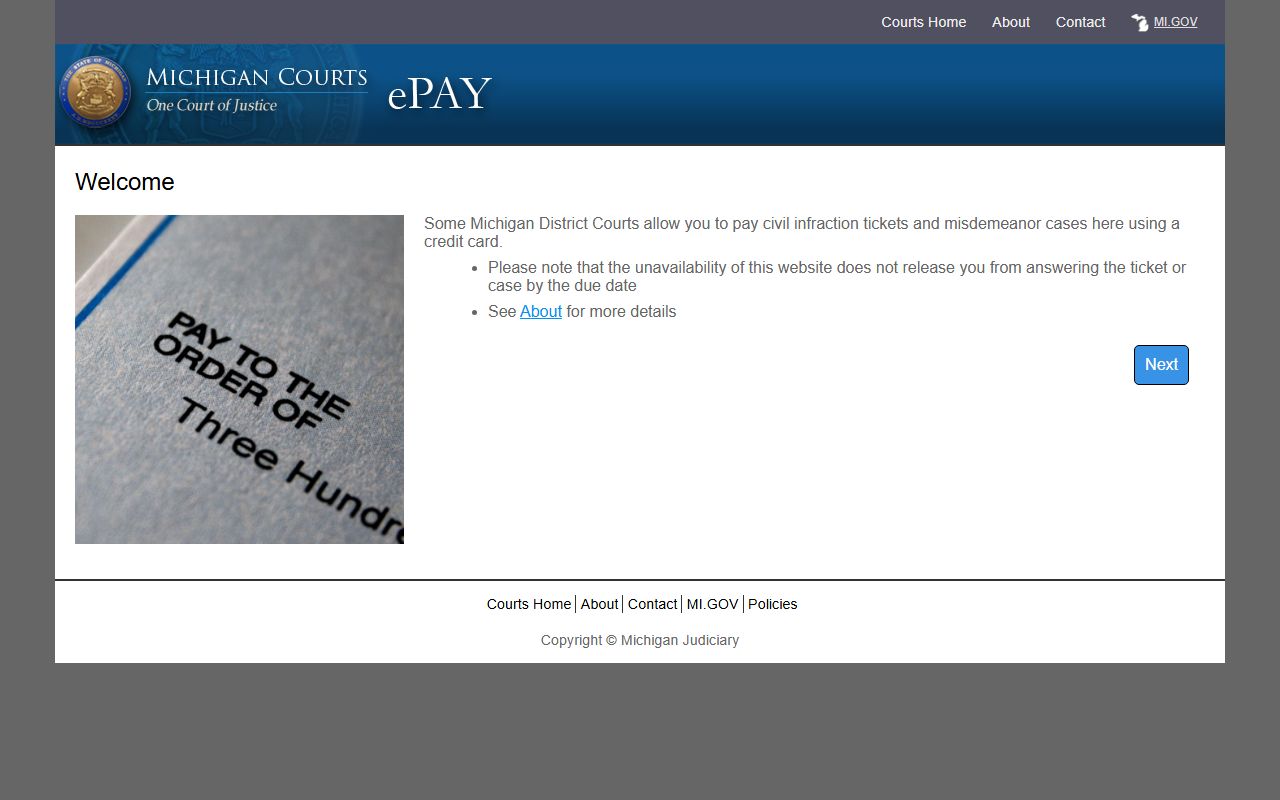
That portal keeps district court, circuit court, probate, and clerk payments in one place. It is a useful stop when a fee is tied to a case you already found in the court files.
The 65B District Court in Gratiot County
The 65B District Court is the busiest court in the county. It sits at 245 E Newark Street in Ithaca, connected to the main courthouse. The office line is 989-875-5240. Judge Stewart D. McDonald presides. The court handles misdemeanors, traffic tickets, civil infractions, small claims, and lower-dollar civil suits. It also does the first step in felony cases through arraignment and preliminary examination.
Most people who deal with a county court deal with this one. A speeding ticket, a landlord-tenant dispute, or a first criminal appearance all land here. The court runs a live public calendar that refreshes through the day, and it supports electronic filing for civil litigants through MiFILE. Staff can also help with ADA and interpreter accommodations at 989-875-5371.
The district court staff page lists the office quick links and contact context for Gratiot County. You can view the 65B District Court staff page for those details. The screenshot below captures that district court landing page.
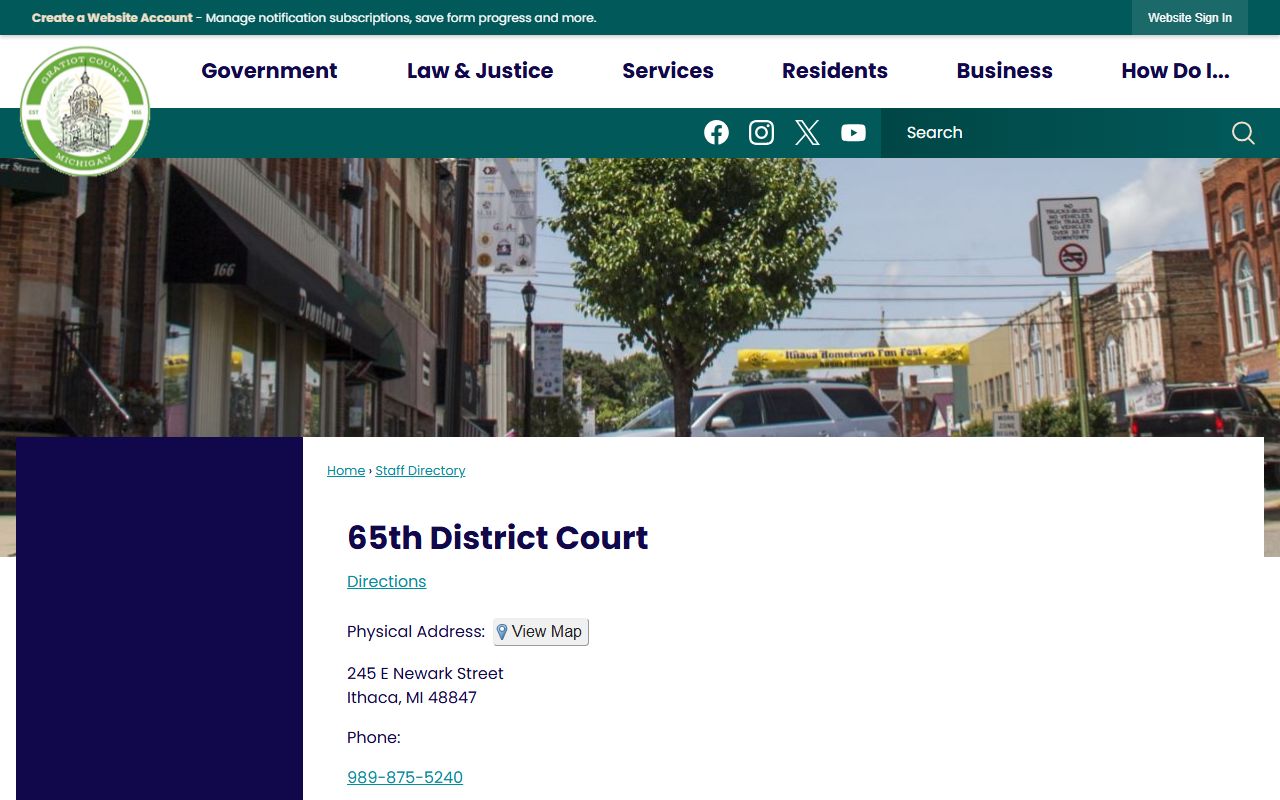
That page ties into the county's other court tools, including the calendar and the online ticket options. It is the right first stop for a traffic or misdemeanor question in the county.
Gratiot County Probate Court
The Probate Court handles the county's estate and protective cases. It shares the main courthouse at 214 E Center Street in Ithaca. The phone is 989-875-5231, and the fax is 989-875-5331. Judge Kristin M. Bakker presides. Hours run Monday through Friday, 8:00 a.m. to 4:30 p.m., closed on holidays.
Probate work covers deceased estates, guardianships, conservatorships, and adult and minor estates. It also handles assignment proceedings, claims, and civil probate actions. Name changes route through this court as well. Michigan recognizes a small-estate assignment path for estates under $21,000, which the county fee page lists. Some probate filings are open for inspection, though personal and medical details can be limited. The Probate Court page carries the judge, address, and contact block for the office.
Note: Probate matters run through the office counter rather than a public online search, so estate and guardianship questions start with a call or a visit.
Searching Gratiot County Court Records
Court records in Gratiot County are open unless a rule or order limits access. The starting point for a case is the court level. Use the Circuit Court for felonies after bind-over, divorce, and larger civil suits. Use the District Court for traffic and misdemeanor files. Use the Probate Court for estates and guardianships. Matching the record to the court is the fastest way to find it.
For an online look, the statewide MiCOURT case search is the top-level tool. You can search by case number, party name, or attorney. The county clerk page also links to the circuit-court case inquiry for the 29th Circuit. Daily hearings show on the district court live calendar, and deeper lookups run through the 65B public terminal. A reader tracking dockets can follow the same channels found in the county court dockets tools.
Access has legal limits set by court rule. Michigan courts are not treated as a normal open-records office. Instead, court-record access follows MCR 8.119 and a local administrative order rather than the state FOIA process. The public terminal for court files is generally open on weekdays during posted hours. Older files before 1996 may need a manual index-book review. Certified copies and record checks are handled through the Gratiot County Clerk, in person, by phone, by fax, by email, or by mail.
Specialty Courts and Motion Day
Gratiot County takes part in two regional treatment courts. The Mid-Michigan Regional Sobriety Court serves Gratiot, Montcalm, and Clinton counties and grew out of a recovery court that began in 2011. The Mid-Michigan Regional Mental Health Court serves Gratiot, Clinton, Montcalm, and Ionia counties. Both run 12 to 24 months across four phases, with treatment, testing, peer support, and review hearings.
These programs sit inside the circuit-court system rather than replacing the normal courts. Judge Stewart D. McDonald presides over the sobriety court for Gratiot. Referral forms are posted on the county court pages. The programs accept felony and misdemeanor offenders who meet the eligibility rules.
Motion day keeps the circuit docket moving. Attorneys and self-represented parties file with the county clerk, then argue scheduled motions on the set day. The county's scheduling guidance explains that flow and helps a filer land on the right calendar.