
About the Gratiot County Clerk
Angie Thompson serves as the Gratiot County Clerk, an elected county officer who keeps and issues many of the county's most important records. The clerk's office is the front door for vital records, marriage licenses, and every circuit court case filed in the county. Staff also run elections, maintain voter lists, and process a range of legal paperwork. The office sits inside the main courthouse complex in Ithaca, the county seat.
Most people reach the clerk for one of three things: a certified copy of a birth, death, or marriage record, a marriage license, or a court record from a circuit case. The office answers questions by phone, fax, and email, and it takes payment several ways. Hours are set, and genealogy help runs on its own limited schedule.
Gratiot County Clerk
Clerk: Angie Thompson
214 E Center Street, Suite 16
Ithaca, MI 48847
989-875-5215
Fax: 989-875-5254
clerkcopier@gratiotmi.com
Mon-Fri 8:00 a.m. to 4:30 p.m.
Genealogy: Tue and Wed, 10 a.m. to noon and 1 p.m. to 3 p.m.
Common questions about fees, hours, and record types are answered on the clerk FAQ page shown below.
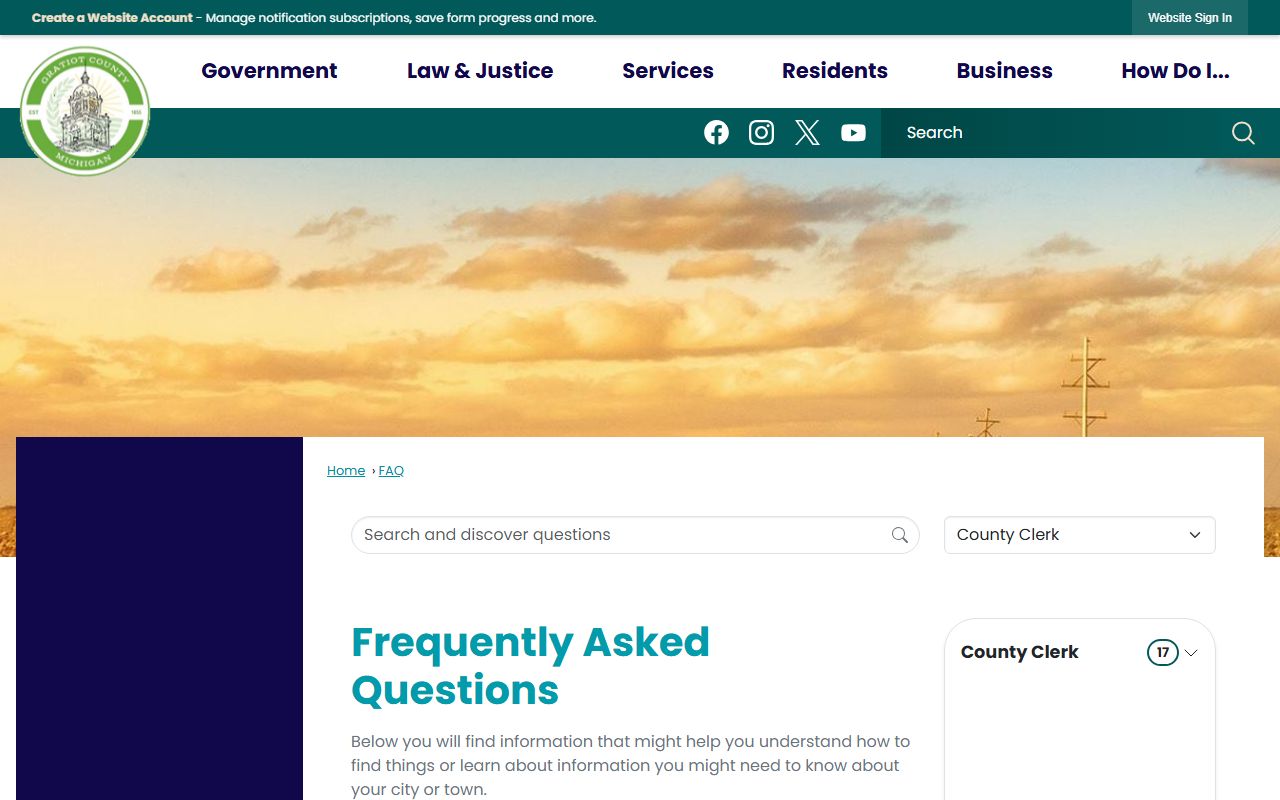
That FAQ covers birth, marriage, and divorce copies, plus concealed pistol license steps and notary details. It is a quick way to confirm what the office holds before you call or visit.
What the Gratiot County Clerk Handles
The clerk wears many hats. Some duties are about records, others are about elections and public filings. The office is the legal keeper of vital records for county events and the filing point for circuit court cases. It also handles smaller but important tasks that residents need at key moments in life, such as recording a military discharge or filing a business name.
- Certified birth and death certificates for county events.
- Marriage licenses and certified marriage copies.
- Divorce judgments and civil copies from county files.
- Circuit civil, criminal, and family case filings.
- Personal protection orders and concealed pistol license support.
- Elections, voter lists, and assumed name (DBA) filings.
- Military discharge recordings and notary paperwork.
Elections are a large part of the job. The clerk maintains voter lists, programs ballots, and manages election work across the county. Assumed name filings let a business run under a chosen name, and military discharge recordings give veterans a safe, certified place for their papers. Each task ends with a record the clerk must keep and, when asked, produce.
Not every service happens at the clerk counter. Passport applications are handled at the Register of Deeds on the third floor. Notary steps are split between the clerk and the Secretary of State. Concealed pistol license fingerprints are done at the sheriff's office after the clerk takes the application. The clerk FAQ points people to the right office for motions, fines, taxes, and name changes so no one waits in the wrong line.
How to Request a Certified Copy
A certified copy carries the clerk's seal and proves the record is genuine. Banks, courts, employers, and government agencies often demand one, since a plain printout will not do. Certified vital copies are backed by Michigan law, which places them inside the official state records system rather than treating them as ordinary paperwork.
Michigan's certified vital-copy rule sits in MCL 333.2883, the statute shown below.
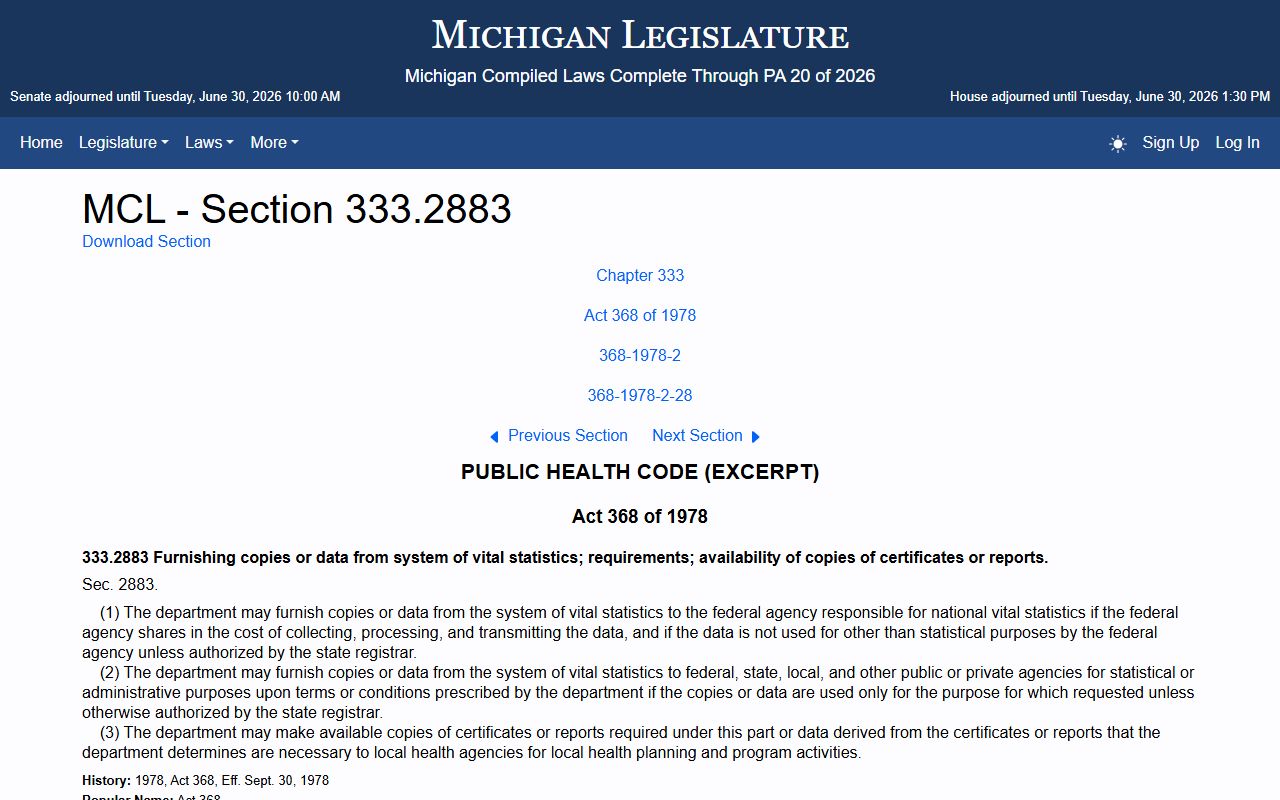
The statute is why a certified copy costs more than a photocopy and why staff must verify who is asking. The steps below work for a birth, death, marriage, or divorce record, or for a circuit court record search.
- Identify the record and the office. Vital records and circuit files sit with the clerk, while probate and district files may sit elsewhere.
- Gather the key details. Have full names, the event or filing date, and a case number if you know one.
- Complete the correct request. Use the record-search form for court files, or the vital-record or divorce request for certificates.
- Pick a delivery method and add payment. Copies can be mailed, emailed, or picked up once the fee is paid.
- Submit the request in person, by phone, by fax, by email, or by mailed written request.
- Receive the certified copy with the clerk's seal, which you can then use for legal or personal needs.
Note: Certified birth, death, and marriage copies can be ordered by phone and mailed back, which saves a trip to the counter for many callers.
Gratiot County Clerk Request Fields
Each request form asks for a short list of facts so staff can find the right file. A court record search asks for the name to search and the timeframe. A divorce request asks for both parties and the divorce date. A vital request asks for the record type and valid identification. Filling every field in full cuts down on follow-up calls and speeds the copy back to you.
| Field | Required | Notes |
|---|---|---|
| Name to search | Yes | Full name for a criminal or civil circuit record search. |
| Timeframe of search | Yes | Each paid search covers a 10-year window per name. |
| Both party names | Yes | Needed for a Judgment of Divorce request. |
| Divorce or event date | Yes | Approximate date of the divorce, birth, death, or marriage. |
| Record or certificate type | Yes | State whether the copy is birth, death, marriage, or divorce. |
| Return address | Yes | Where the clerk mails the finished copy. |
| Daytime phone | Yes | Lets staff call with questions about the request. |
| Signature and valid ID | Yes | The written request is signed, and vital copies need proof of identity. |
Gratiot County Clerk Fees
Fees fall into two groups: the cost to file or apply, and the cost to buy copies. The clerk collects vital-copy, license, and court-search fees, while circuit filing fees apply once a divorce case opens. Seniors and same-time copy buyers pay reduced rates. The figures below come from the county clerk fee schedule and the clerk FAQ.
| Item | Amount |
|---|---|
| First certified birth, death, or marriage copy | $26 |
| Each additional same-time certified copy | $12 |
| Senior (65+) first and each same-time copy | $7 |
| Copy emailed | $4 |
| Photocopy per page | $1 |
| Circuit court record search (per name, 10 years) | $12 |
| Court record copy on CD | $25 |
| Divorce true copy per page | $1 |
| Divorce certification added to a copy | $10 |
| Marriage license (Michigan resident) | $20 |
| Marriage license (out-of-state) | $30 |
| Waiver of the three-day waiting period | $15 |
Divorce filing fees are separate from copy fees. The clerk FAQ lists a filing fee of $175 without minor children and $255 with minor children, plus a $50 divorce packet for cases without children. Those apply when a new case opens, not when you buy a copy of a finished judgment.
Vital, Marriage, and Genealogy Records
The clerk keeps certified birth, death, and marriage records for events tied to the county. Marriage records cover licenses applied for in Gratiot County. Michigan sets the vital-records framework in MCL 333.2882, and the marriage-license rule in MCL 551.102 routes applications through the county clerk. Certified copies can be ordered in person, by phone, or by mail, and staff mail the copy back. Full details on licenses and certified marriage copies live on the county marriage and divorce records page.
For older records, the clerk holds bound index books that predate the digital era. These volumes cover birth, death, and marriage entries by name and year. Genealogy access runs on separate hours because the old books take staff time to pull and search by hand. The county's Birth Index-A page is shown below.
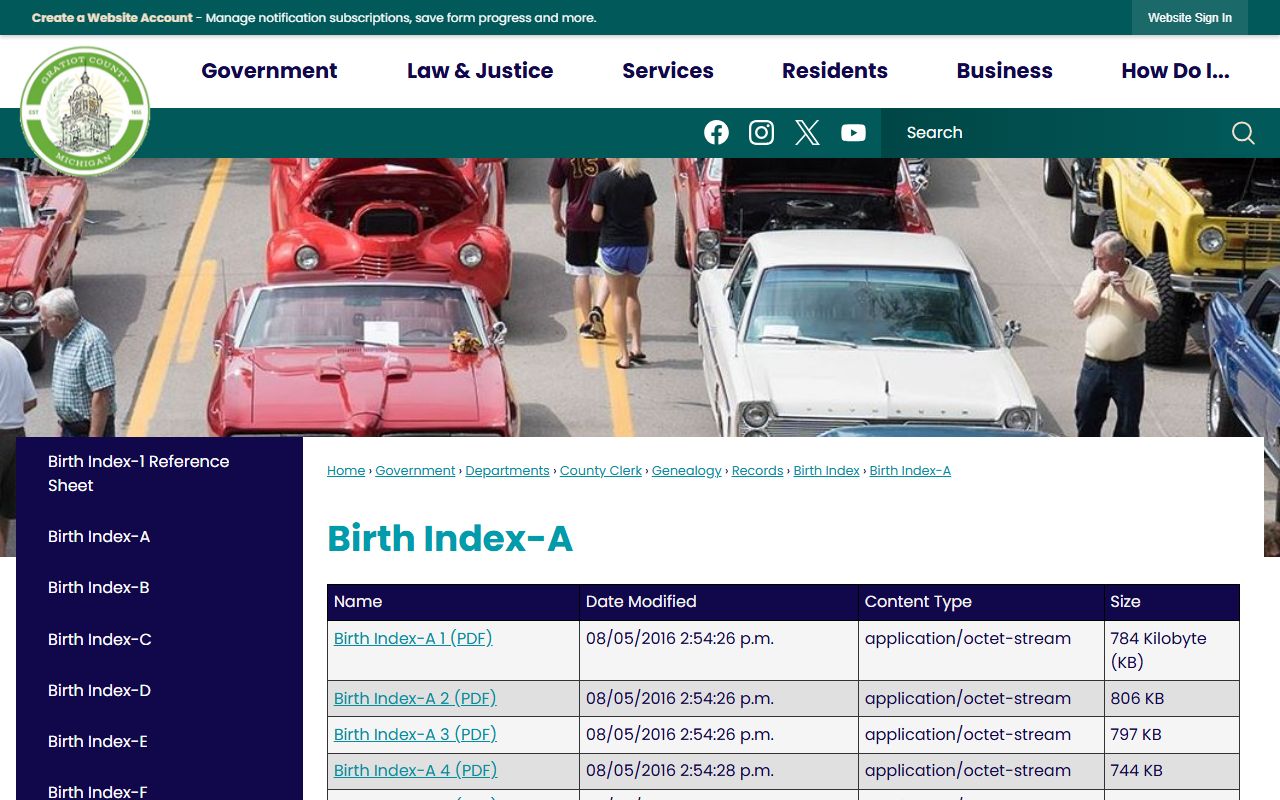
The index pages show how the old books are organized, with Birth Book A, Death Books, Marriage Books, and several marriage index volumes. Family researchers use these to trace lineage, which often ties back to an estate or a probate matter. The clerk FAQ confirms the vital-copy fees and the by-phone ordering that many out-of-town researchers rely on.
Circuit Filings and Clerk Payments
The clerk is the filing point for the 29th Circuit Court. All circuit civil, criminal, and family cases are filed in the County Clerk's Office, then routed to the court as needed. Motions and briefs also start at the clerk counter. Case information and hearing scheduling run through the circuit clerk line at 989-875-5224. The county page links to the MiCOURT case inquiry for docket C29-2, so parties can track a case online after it is filed.
Court records are not treated like ordinary public records under Michigan FOIA. The Freedom of Information Act, MCL 15.231, declares public records open, but courts follow their own access rule instead. Under MCR 8.119, court records are open unless a rule or order limits access, and sealed or non-public files stay off the public view. Statewide court lookups start at the MiCOURT case search, while the clerk remains the first local stop for a certified circuit record. More on the filing path sits on the circuit court filings page and the county's circuit court page.
Paying the clerk is simple. The office takes cash, check, money order, and debit or credit card. Phone and online payments run through GovPayNow using PLC code 5159. Choosing the right payment method up front keeps a mailed or emailed copy moving without delay.
Note: The clerk cannot process a passport at the main counter, so passport applicants should go straight to the Register of Deeds on the third floor.